
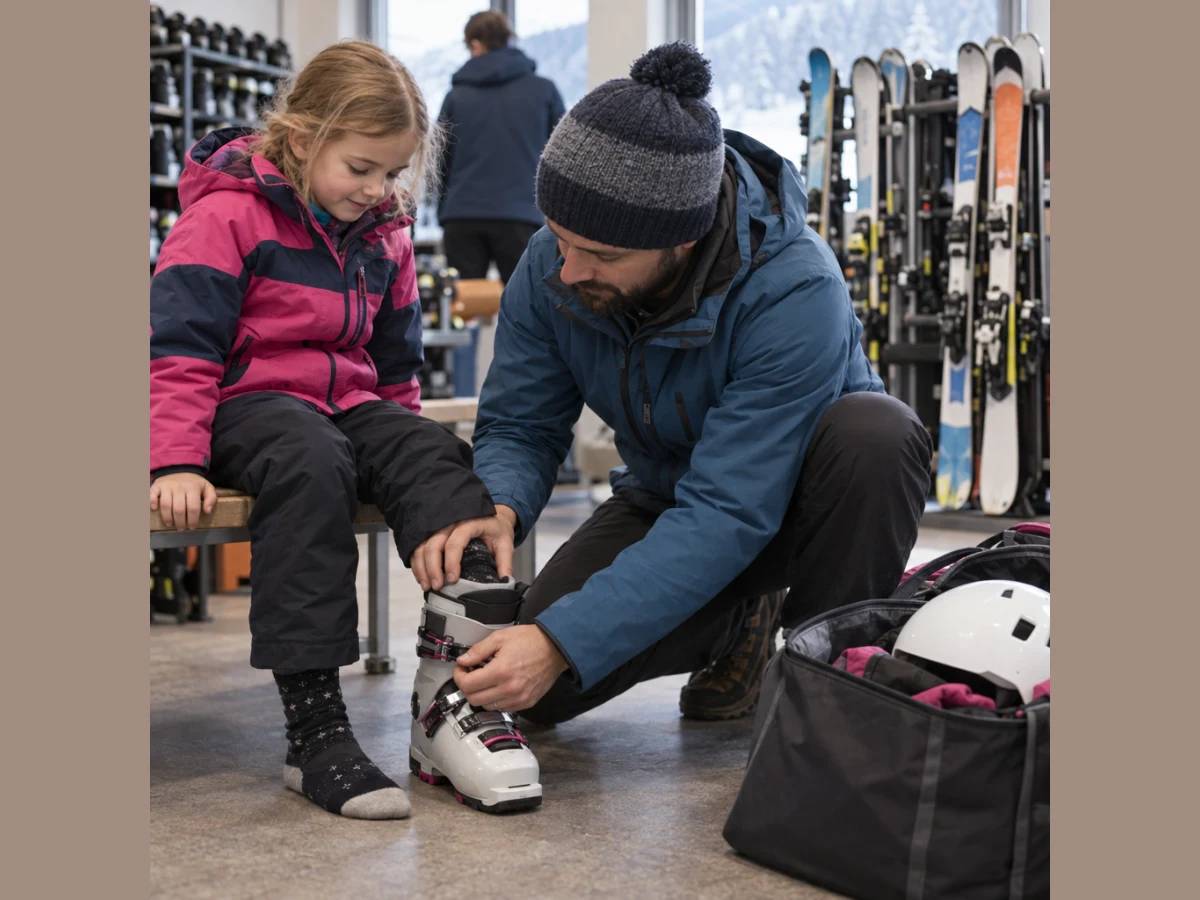
Before the season, note down two estimates: how many days the child will realistically ski during the chosen period, and how certain you are that their current equipment size will remain usable. If both answers are uncertain, the price of a full set alone can be misleading. Assess skis, ski boots, poles and protective equipment separately, then decide whether to buy, hire or combine them.
Start with two inputs: usage and size uncertainty
Do not fill in the first column with an optimistic plan, but with the period over which you want to compare both options. This may be one season, several seasons or an expected number of days on snow. Use the same time horizon for buying and hiring; otherwise, you are comparing different situations. For several seasons, note the uncertainty for each one separately.
If dates are not yet fixed, do not look for one exact number. Note a lower scenario with almost certain usage and a higher scenario in case of additional trips. This gives you a useful range rather than false precision.
The second column expresses how certain you are that each item will remain usable during the chosen period. Do not assess future suitability only by age or height, or by allowing an undefined ‘room for growth’. Start with current measurements and trying the specific item on. Keep the two variables separate: a firm plan does not guarantee a stable size, and a stable size does not guarantee that the planned days will happen.
- Family with one uncertain trip: allows for both lower and higher usage for each item.
- Family with a recurring plan but uncertain size changes: does not treat frequent skiing as proof that the whole set will last equally long.
Therefore, split skis, ski boots, poles and protective equipment into separate decision paths. Once they all have the same time horizon and two usage scenarios, you can create a comparable calculation for buying and hiring.
Compare the full life cycle, not two price tags
Turn the chosen time horizon into a worksheet. Create a separate row for skis, ski boots, poles and each piece of protective equipment, so that the value of one item does not conceal the costs of the others.
Blank calculation template for each row:
- Buying: purchase price of the item + necessary servicing or professional adjustment + essential accessories + delivery + storage − realistically estimated residual value.
- Hiring: total hire prices for the chosen number of days or seasons + only those services, delivery costs or fees that are not included under the verified terms.
- Further use within the family: include it only if the item will later still be suitable in size, condition and compatibility. The mere existence of a younger sibling does not reduce costs.
- Unknowns: price ___; servicing or adjustment ___; delivery ___; storage ___; residual value ___; excluded fees or terms ___.
If you only know the price of the full set, do not estimate how to divide it between the items. Record the set separately, list its components and leave the price as unknown in the individual rows. Not every component in a package may offer the same value.
Calculate each row for both the lower and higher usage scenarios. If the result changes, the decision is sensitive to the actual number of days. Use a per-ski-day calculation only as a supplement to the total amount, so it does not obscure one-off costs or residual value.
Do not replace an unverified price or term with an assumption. Leave it as something to check; without specific inputs, no universal break-even point can be determined. Skis can be the first separate row.
Skis: ownership depends on suitability and further use
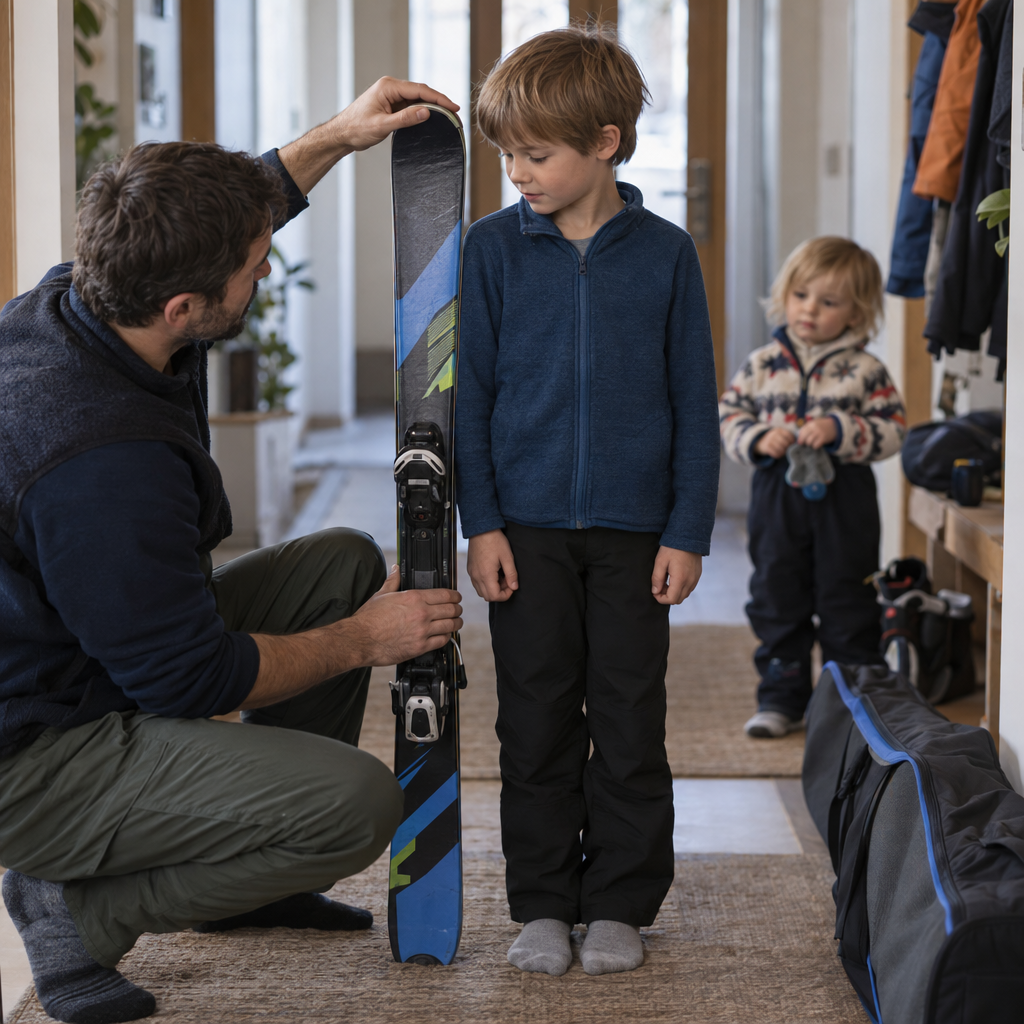
For skis, entering a price is not enough. First confirm that the model being considered suits the child’s current measurements, beginner level and planned use. When choosing children’s ski length, do not rely only on age or a universal chart. Base the decision on current measurements and information for the specific model, or on the hire provider’s procedure.
Buying path: Owning skis starts to make sense when repeat use is sufficiently likely and justifies the cost of purchase, servicing, professional adjustment and storage. The option to pass the skis on to a sibling or sell them later improves the balance only if they will still be suitable in size, condition and compatibility.
Hiring path: For one uncertain trip or unclear future suitability, flexibility may be more valuable. However, check the availability of the right size and what the service includes. Enter the currently established price for the same period used for buying in your calculation.
The first family may take only one trip and has no further trip planned yet; ownership would rely on unconfirmed usage. The second plans to ski repeatedly and may be able to pass the skis on to a younger sibling. Buying is the stronger path for them, but only after confirming that further use is realistic.
For both bought and hired skis, have their condition, ski-boot-to-binding compatibility and any necessary adjustment checked professionally. The answer to when it is worth buying children’s skis therefore comes from combining suitability, expected usage and the full calculation.
Ski boots: current fit first, costs second
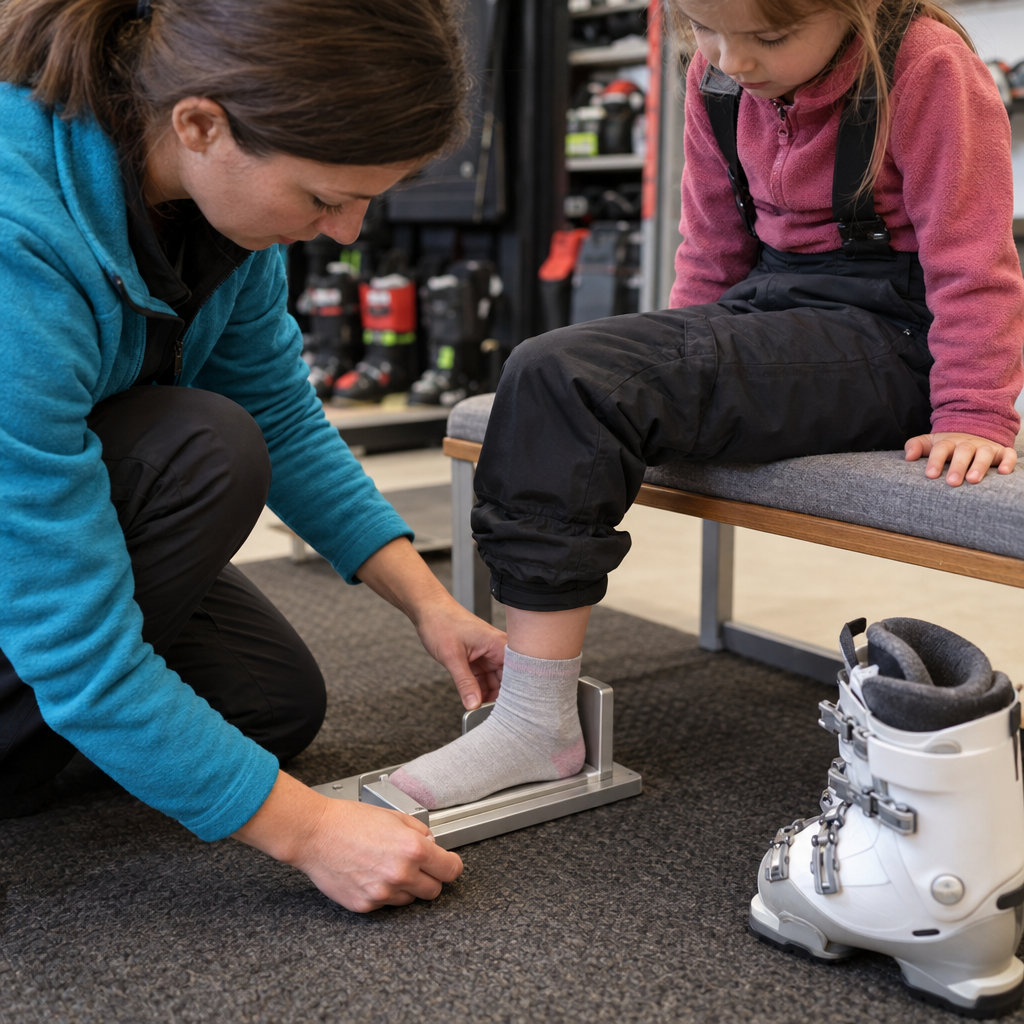
For ski boots, reverse the order of decision-making: first confirm that they currently fit, then consider buying or hiring. Measure the child’s foot again before the season and let them try on the specific model. A size marking from the previous period does not by itself confirm internal space, foot retention or comfort.
When trying them on, assess the fit now, not a future created by unspecified ‘room for growth’. If a ski boot pinches, is uncomfortable or does not hold the foot adequately, a favourable price or hope of another season does not make it a suitable choice. Compare prices only between models that currently fit the child.
Last year’s size marking may remain the same, yet new measurements or trying the boots on may raise doubts. Check the size again in that case. A calendar does not determine how often children’s ski boots should be changed; changed measurements, visible growth, pressure, discomfort or uncertainty about whether the boots still fit call for another check.
- Hiring: where a size change is likely, the option to exchange them may be beneficial, but include it only if the specific provider actually offers it and you know the terms.
- Buying: consider it only after a successful fitting. If a size change is likely within the period considered, do not automatically assume one pair will cover the whole time horizon. Take further family use into account only where the size and condition are suitable.
For both owned and hired pairs, have ski-boot-to-binding compatibility and any necessary adjustment checked professionally. Then assess poles and protective equipment as separate items.
Do not automatically treat poles and protective equipment as part of the set
For further items, first ask whether the child will use them at all. Their inclusion in one set does not mean they should be obtained in the same way.
Poles
Check whether poles suit the planned lessons or style of skiing and whether they are included in the hired set. If they will be used, check the current size, condition and rules for any exchange or return. If they are not needed, leave them out of the cost comparison. Include future use or passing them on to a sibling only if their size and condition will later still be suitable.
Protective equipment
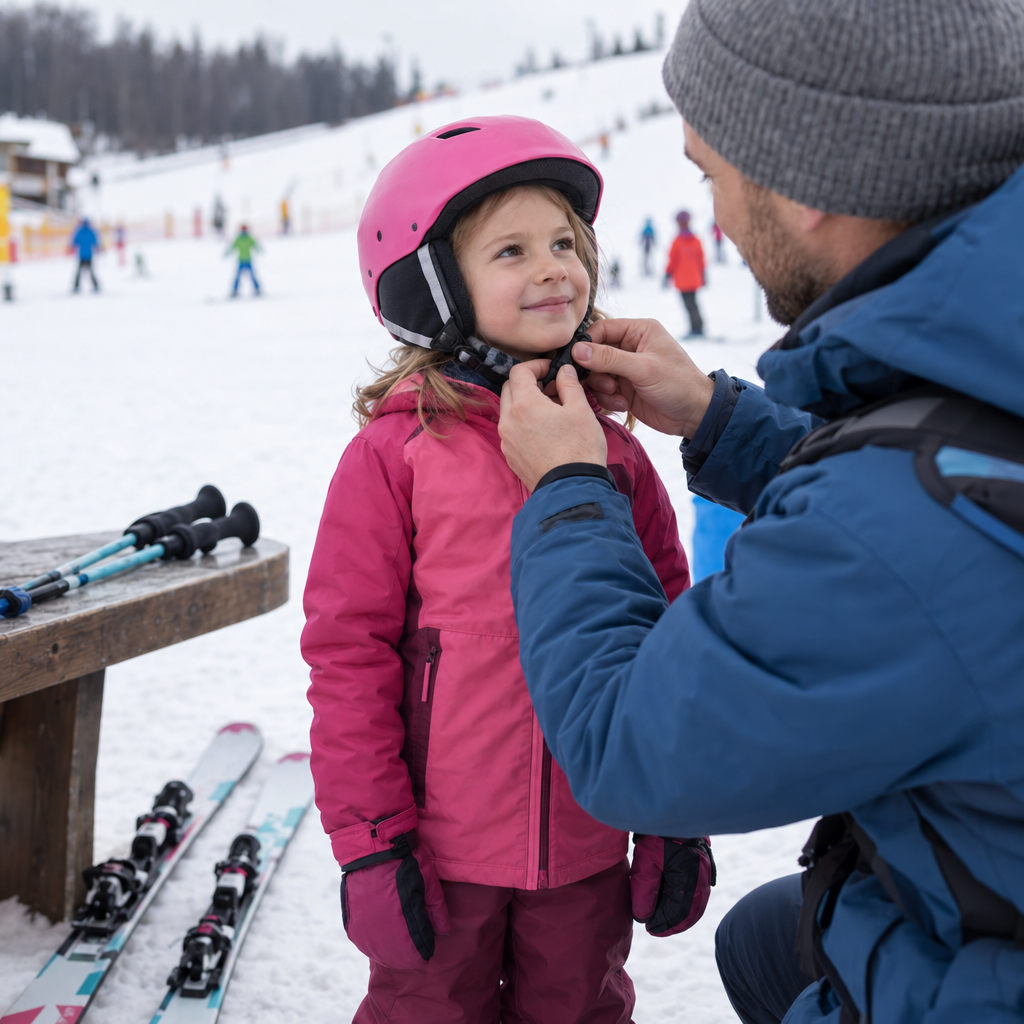
Assess a helmet and every protective item under consideration separately according to its current fit, condition, known usage history and the provider’s terms. Ownership may support personal comfort and control over use. Where size is uncertain, the flexibility of hiring may be more valuable if the service offers a suitable option. Even with a hired item, do not rely only on the size marking; the child should try on the specific item.
For planned lessons, for example, it may turn out that poles are not needed or are already included in the set, while the family assesses a helmet separately according to fit and conditions of use.
For each item, compare purchase and realistic further use with the hire price. Before finalising the row, however, confirm what the offer actually includes.
Before comparing offers, check what the price actually includes
The same label, ‘children’s set’, does not necessarily mean the same contents. One offer may include skis, ski boots and poles, while another includes only skis and ski boots. The period and services may also differ. Until you standardise these items, even similar prices will not show which offer has lower overall costs.
- Contents: list skis, ski boots, poles and each piece of protective equipment separately. Also note anything that must be bought or hired outside the set.
- Duration: confirm from when to when the price applies, how the provider counts a day, weekend or season, and the terms for extending the hire.
- Size: find out whether the correct size is available and whether it can be exchanged during the hire period, within what timeframe and under which terms.
- Servicing and adjustment: check whether the price includes a condition check, compatibility check and professional adjustment, or what you need to arrange separately.
- Collection and return: check delivery or collection location, the return date and location, the deposit, and possible fees for extensions, damage or late return.
- Final details: confirm the current price, availability of the correct size, condition of the specific items, and commercial and service terms directly with the provider or partner shop.
If any information is missing, do not automatically treat the service as included. Mark it as unknown and ask for confirmation. Zoneo can be used for an initial comparison of relevant parameters and offers, not as confirmation of live information. Individual paths can be finalised only after verified answers have been added.
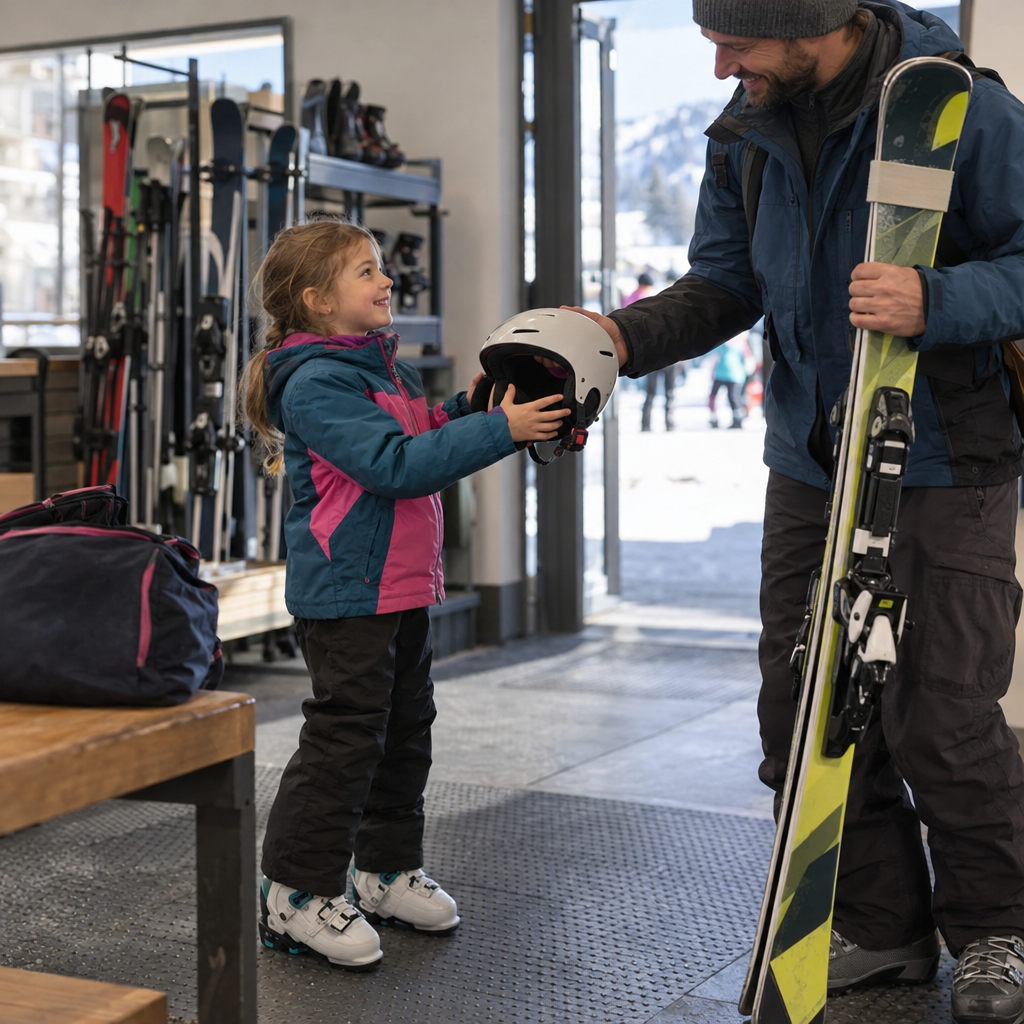
Combine the paths into owned, hired or mixed equipment
Finally, turn the worksheet into a decision map. For each item, write ‘owned’, ‘hired’ or ‘undecided for now’. Alongside it, add the deciding input, such as certainty of repeat use, an expected size change or the possibility of further family use.
- Mostly owned equipment: repeat use is sufficiently predictable and ownership makes sense for each included item. Do not choose a full set simply because it is sold that way.
- Mostly hired equipment: uncertainty about the number of days or future size is high, and confirmed hire terms cover the necessary items and services.
- Combination: you can combine owned skis, where repeat use is predictably frequent, with hired ski boots where size is uncertain. Another option is a hired main set and an owned protective item, if this better suits its fit and conditions of use.
A mixed solution is not a stopgap compromise. It reflects the fact that each part of the equipment has a different cycle of use and size changes. If a deciding detail is missing, leave the item undecided for now and finalise the outcome only after confirming the current price, availability, service contents and offer terms.
Before the next season, do not automatically repeat last year’s choice. Repeat the measurements, estimate of ski days and calculation template. The right answer to whether to buy or hire children’s ski equipment may change along with the child, the skiing plan and the live terms of offers.