

A lightweight burner can look like an obvious choice on a product page. But its weight solves nothing if you cannot use or transport the system, or cannot obtain the exact fuel on your route. Start by working through the elimination gates. Only then compare gas, petrol and spirit by cooking method, conditions and the weight of the complete kit.
First gate: can you use and transport the stove?
Before comparing a gas, petrol or spirit stove, obtain two independent answers for every candidate. An assumption of ‘probably yes’ is not enough: the result must be either confirmed or unconfirmed for the exact route and dates.
- Use: confirmed/unconfirmed. Check the current rules for the specific place, time and intended use with the land manager or relevant authority. Do not treat an answer from another location or an earlier trip as valid.
- Transport: confirmed/unconfirmed. Break the journey down into individual transport legs. Assess transport of the fuel and all other parts of the setup for each one, under the current conditions of the specific carrier and relevant authority. A general assumption about gas or liquid fuel is not enough.
Keep the two checks separate. Confirmed transport does not mean use is permitted, and confirmed use does not prove that the setup can be transported. For every positive result, note what you checked, for which leg or location, and for what date. Repeat the relevant check if the carrier, route, date or cooking location changes.
Imagine travelling by car to the station, then by train and finally on a local bus. The same setup must pass a separate check for each leg, followed by a check on using it at the destination. This filter applies equally to all three systems.
If any result remains unconfirmed, rule out the system for now, or change the transport, cooking location or meal plan. Weight, output and an attractive price do not override this gate. For candidates with both answers confirmed, the next question is: can you secure the correct fuel for the whole journey?
Second gate: do you have the exact fuel and a backup plan on the route?
For candidates that pass the first gate, knowing that they burn ‘gas’, ‘petrol’ or ‘spirit’ is not enough. Fuel availability for a stove while travelling can only be assessed from the exact requirements of the specific setup and a plan for the entire trip.
- Exact fuel: From the documentation for the intended model, copy the exact designation of the permitted fuel and the required form of supply or container. A general fuel-category name does not confirm compatibility.
- Start of the trip: State where you will obtain the initial supply and whether it covers the plan without refilling. Keep the result of the transport check in mind.
- Refilling or replacement: Mark the specific points on the route where you would replace or top up the supply, and confirm the exact type for the relevant dates before departure. Do not treat any fuel as automatically available.
- Quantity needed: Base this on the planned number of uses and verifiable data for the specific model. If you do not have that basis, do not calculate consumption using a universal rule of thumb. Adjust the plan instead.
- Backup: If a source at the destination is not currently confirmed, treat it as uncertain. Choose a feasible option in advance: carry a permitted supply, change the meal plan, route or fuel system.
On a weekend route, a favourite may have interesting claimed features, but if you intend to obtain its exact fuel only at the destination and have not confirmed the source, it has failed the logistics test. The backup decides before the burner’s features do: a supply secured in advance within confirmed conditions, different meals or another system.
Write ‘logistics viable’ or ‘rule out’ next to each candidate. Only a setup with the exact fuel, a feasible supply and a specific backup moves on. Only then does it make sense to consider what it will cook and for how many people.
Cooking branch: water, food for one or a pot for a group
Once you know you will have fuel, replace the question ‘which system is better?’ with a specific task: how often will you cook, what will you prepare and for how many people? Then apply the same brief to all remaining candidates.
- Heating water only, or controlled cooking? For water, check whether the intended setup supports your pot and required operating mode. For food that is not simply brought to the boil, also note from the documentation the method and range of adjustment, and whether it can be maintained during preparation. The fuel label alone does not provide the answer.
- One portion, or a shared pot? A solo hiker heating water in a small pot has a different task from a pair preparing controlled food in a shared pot. In the latter case, check permitted pots and configurations, supports for the planned pot, and instructions for positioning the setup stably. Do not infer suitability for several portions from burner size alone.
- Occasionally, or repeatedly? One heating session on a day hike and several planned cooking sessions over a weekend are different tasks. Note the number of uses and assess for every candidate whether its permitted adjustment and use method suit this pattern. You dealt with fuel supply in the previous branch. Here you assess the cooking itself.
Whether you are comparing a gas, petrol or spirit stove, ask the same three questions: Does the documentation state the required level of control? Does it support the planned pot and configuration? Does the operating mode suit the number of cooking sessions and portions? Do not automatically assume a spirit system has more limited control or longer heating times. Without comparable data, these features must be checked for the specific setup rather than attributed to the whole category.
If the documentation does not confirm the required cooking task, pot or configuration, rule out the model for that use. The outcome of this branch should be an exact profile, for example ‘repeated controlled cooking for two in a shared pot’. You can then list all the parts that will genuinely need to be carried for each fuel system.
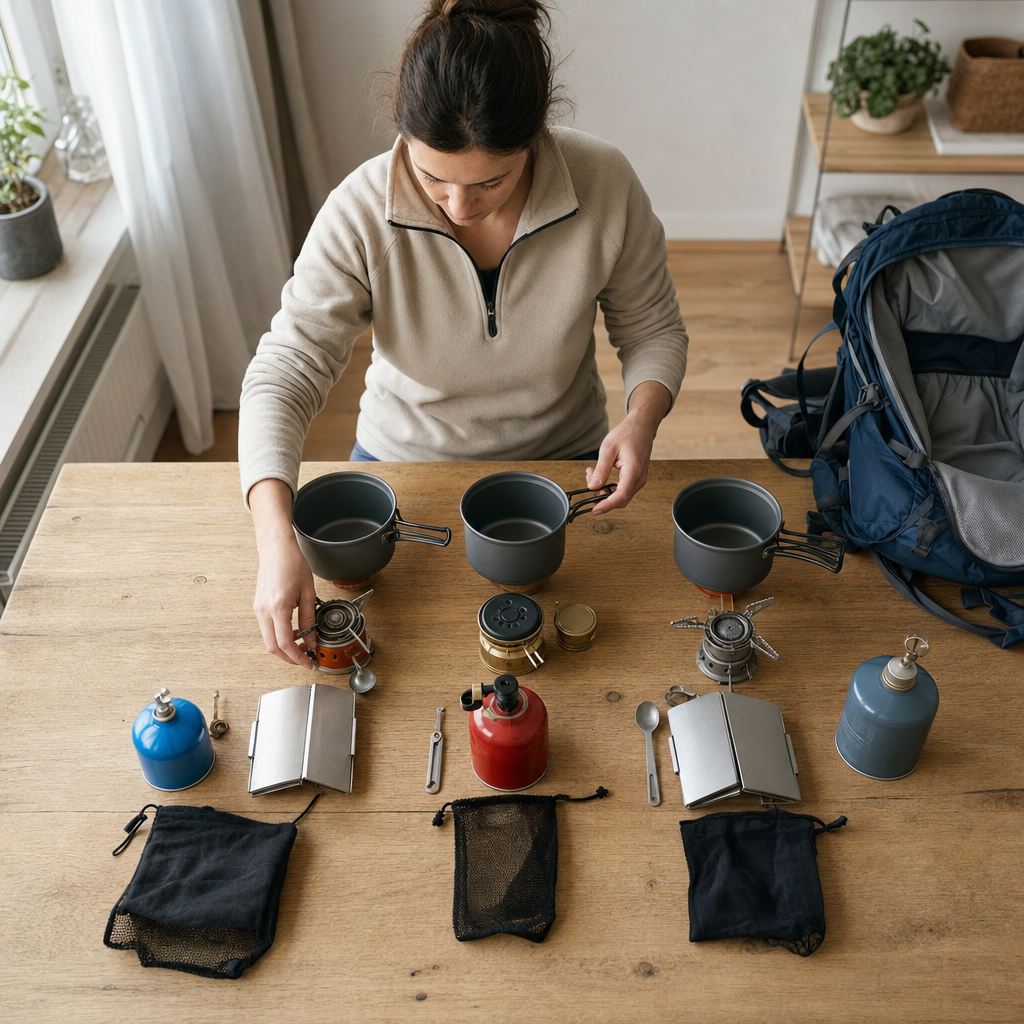
Count the whole kit, not just burner weight
Now turn the cooking profile into a comparable brief: the same trip length, the same number of uses and the same cooking task for gas, petrol and spirit. Otherwise, you would be comparing three different trips, not three solutions to one problem.
For each system, name the specific model and variant that have passed the filters so far. The list should include the burner or stove body, fuel supply, relevant fuel container, cookware, and only the pump, support, windscreen or other part required or permitted by that model.
Use the same comparison point for weight — for example, departure with supplies for the whole plan — and compare packed complete kits for volume. If you use the same cookware in all setups, list it in every column. List different cookware only where it is confirmed for the relevant model.
The table columns represent three specific complete setups for the same brief, not average characteristics of fuel categories. Enter part names and verified values for the exact variant in the cells.
Three complete setups for the same trip
| Item or parameter | Gas | Petrol | Spirit |
|---|---|---|---|
| Burner or stove body | Model and variant | Model and variant | Model and variant |
| Weight of complete setup | Verified full total | Verified full total | Verified full total |
| Packed volume | Packed complete kit | Packed complete kit | Packed complete kit |
| Fuel for planned uses | Name and quantity | Name and quantity | Name and quantity |
| Fuel container | Exact type | Exact type | Exact type |
| Required accessories | Part names | Part names | Part names |
| Compatible cooking pot | Exact cookware | Exact cookware | Exact cookware |
Once completed, the specific column that combines the lowest verified total with an acceptable volume has the lowest overall burden. Even a lightweight stove for solo hiking does not automatically mean the lightest complete setup.
Burner A may be marginally lighter than burner B, but after adding fuel, the container and a required part, complete setup A may be heavier or bulkier. The order changes even though the cooking task remains the same.
If a part’s weight or dimensions are missing, mark it as data to verify. Do not replace it with an estimate based on another model or a general assumption about gas, petrol or spirit. This gives you a realistic picture of both the weight of the whole kit and the space it takes in your rucksack. Next, check whether the chosen complete kit suits the conditions on the route.
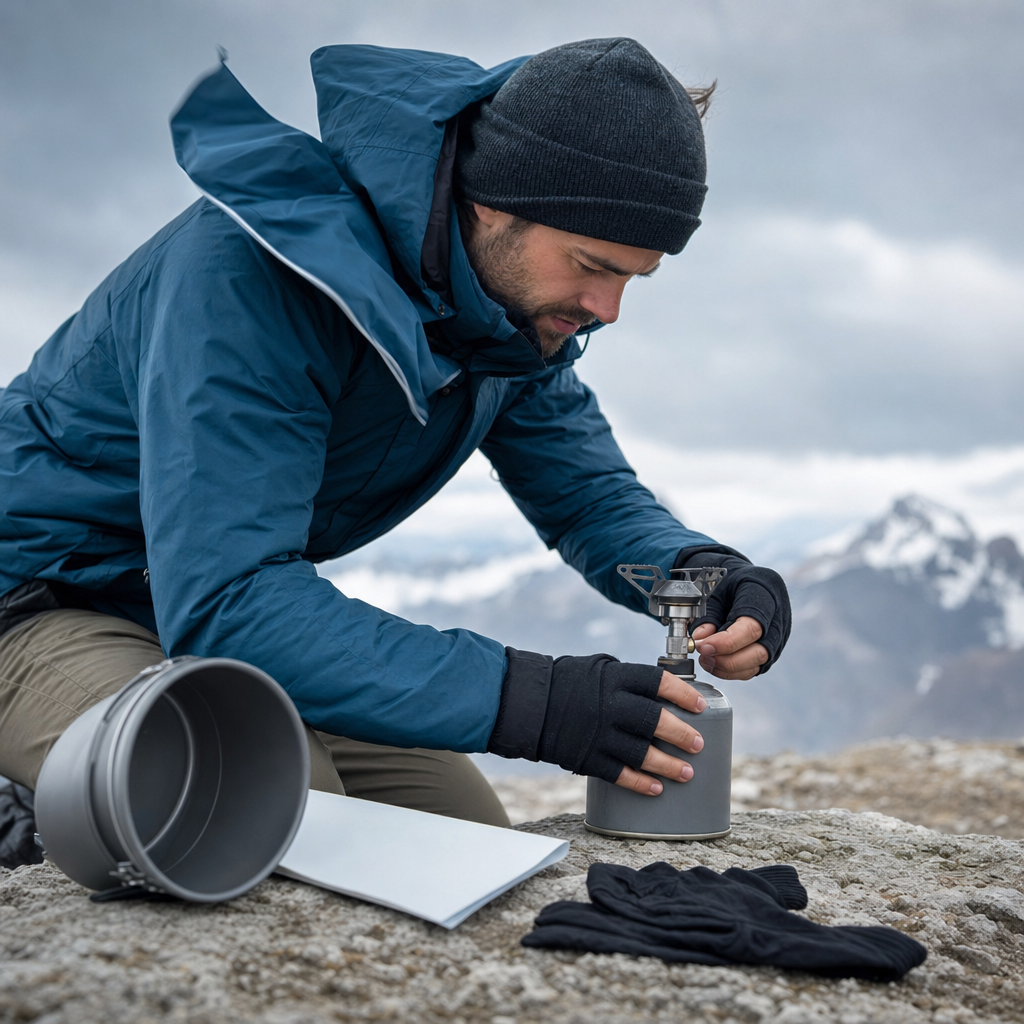
Wind and cold: the limits of the specific setup decide
A kit that proves light and compact may still not suit your route’s environment. First describe the conditions without universal thresholds: will you cook in an exposed place, in shelter, during windy sections or in noticeable cold? Base this on the place and time of planned use, not just the daily forecast for the wider area.
- Operating data: In the exact model’s manual, look for the conditions in which the manufacturer describes or permits use, and any limits it states. If you cannot find an answer, do not treat the label ‘cold-weather hiking stove’ as confirmation.
- Fuel: Check the exact permitted type or composition and whether the stated operating data apply specifically to the fuel you plan to carry. A general assumption about gas, petrol or spirit is not enough.
- Configuration: Check that the limits apply to your variant, fuel container, intended operating mode and all necessary parts. Do not transfer data for another configuration to your setup.
- Wind protection: Use only a method and accessories that the documentation expressly permits for that model. Improvised shielding and a general label such as ‘windproof stove’ do not replace such confirmation.
For example, on a weekend hike you expect to cook in an exposed place and face cold mornings. For the first candidate, you find only a general claim about the fuel category. For the second, data for another fuel or configuration. And for the third, verifiable data for the exact variant, fuel and permitted wind protection. Only the third remains confirmed for this plan. The first two may not be unsuitable in general, but their suitability for the intended trip is not confirmed.
Without comparable data, do not rank systems as the fastest, most economical or most powerful. The rule is simple: if the documentation does not confirm the exact setup in expected conditions, rule out the candidate for this trip. For setups that pass, the human filter comes next — the demands of operation and maintenance.
Operation and maintenance: how much work are you willing to take on?
After the technical check comes a personal limit: can you manage everything the specific setup requires every time you use it, not only starting it? Rule out a stove whose operating cycle you do not want, or cannot reliably follow, even if it passes on weight and conditions.
For every candidate, open the manual for the exact model and, without describing the procedure itself, list the full cycle: preparation, starting, adjustment, shutdown, cooling and packing away. Give each stage one of these ratings: acceptable, I need to practise or unacceptable. For the second option, decide before the trip whether you have time to become familiar with the procedure using the manual. The third answer is a reason to rule it out, not a detail to solve on the route.
Divide the requirements by when they need to be carried out:
- During the trip: How much attention do operation, shutdown and packing away require according to the manual?
- For the fuel supply: What replacement or refilling method does the manufacturer permit, and what checks of the container or connections does it state?
- After returning: What cleaning, drying, checks and storage are needed before the next use?
- Regularly: What maintenance or servicing tasks, tools and intervals does the documentation state?
Do not define the difference between gas and petrol stoves using a general rule of thumb. Likewise, do not assume one operating procedure for all spirit models. Compare manuals for the exact designs, including model-permitted fuel replacement or refilling. Without suitable evidence, you cannot say that every petrol stove requires more steps and maintenance than every gas stove.
A user who wants minimal handling on a short trip may rule out a setup with several unacceptable stages. Another person, willing to follow a more extensive model-specific procedure and carry out regular maintenance, may keep it. What matters is whether you can carry out the required tasks reliably even when tired and uncomfortable.
This article deliberately does not explain ignition, filling or repairs, and does not replace the documentation for a specific model. You can now combine setups with an acceptable operating cycle with the previous filters and assess them for the specific type of trip.
Combine the filters: which system remains for your type of trip?
Once only setups whose operating cycle you are willing to manage remain, combine the results into one process. Use the same six steps for every candidate and rule it out at the first failed one.
Repeatable process for every trip:
- First rule out any system whose use or transport is not confirmed for the entire journey.
- Check the plan for the exact fuel, the initial supply and the solution if refilling is unavailable.
- Assign it the real cooking task: water, controlled food or a shared pot.
- Compare complete setups ready for the same number of uses, not isolated burners.
- Keep only configurations whose data suit the expected wind and cold.
- Finally, filter out operating and maintenance procedures that you do not want or cannot carry out reliably.
Do not compensate for the first two steps with scoring: lower weight does not outweigh unconfirmed transport or fuel. In the next four steps, record ‘suitable’, ‘unsuitable’ or ‘data missing’ for every candidate. Missing required data is neither an advantage nor a neutral draw. The candidate stays aside.
After this process, a gas, petrol or spirit stove may remain, but the fuel name is not itself the result. Keep a gas setup only with confirmed exact fuel and connection, suitability for the cooking task and conditions, and acceptable operation. For a petrol setup, require the same certainty about permitted fuel, transport, the complete kit, operating data and the operating cycle. Do not choose it automatically just because you expect cold. Keep a spirit setup only if its documented control, supported pot and operating configuration meet your meal plan.
Five typical outcomes
- Solo water heating: If you are looking for a lightweight stove for solo hiking among viable candidates, compare the weight and volume of the whole kit alongside the number of tasks involved in use. The lightest burner may not create the lightest or simplest complete kit.
- Day trip: The advantage goes to a candidate whose supply is confirmed at departure and whose operation makes sense for brief use. Do not count an unverified refilling option at the destination in the decision.
- Weekend with regular cooking: Consider all planned uses, the control required, supplies for the stay and the full operating cycle. A system that suited one heating session may not pass this different brief.
- Shared pot for a group: Keep only specific setups whose documentation supports the planned pot, whose configuration is stable for it, and whose control and operating mode match the intended portions.
- Multi-day route with uncertain refilling: When considering which stove for a multi-day trek, calculate the supply and complete burden for the longer plan. Rule out a candidate dependent on an unconfirmed fuel source, or change the fuel or meal plan.
If two candidates survive, decide by the lower overall burden for this trip: the kit carried, fuel uncertainty, operating demands and limits in expected conditions. The right result is not a general winner but a specific setup for which you do not need to bypass any filter. The same type of stove may therefore suit one plan and be ruled out for another. Its exact model and variant still need checking before you order.
Before ordering, check the model, fuel and what is included
Now turn the outcome of the previous decision-making into information about a specific product. For every point, look for a match for the exact model designation and variant, not a similarly named stove.
- Model and fuel. Copy the full variant designation and the fuel stated in its manual. Do not automatically transfer information from another variant or a general label such as ‘gas’, ‘petrol’ or ‘spirit’.
- Gas connection. For a gas variant, find the exact connection type in the documentation and explicit information about which cartridges or fuel containers the model uses. If the answer is missing, cartridge compatibility with gas stoves remains unverified for that variant. Do not assume that connections or adaptors are interchangeable.
- Pot and accessories. Check the supported type and dimensions of cooking pot, along with the permitted configuration of supports, stabilisers, windscreens, adaptors and other parts. Put only accessories intended for that model on the shopping list.
- Operating data. Compare the data for wind and cold with the planned use. Check that they apply to the exact fuel, variant and setup you intend to carry, not to the category in general.
- Package contents. Separate parts that are included from those bought separately. Do not treat an illustrative photograph as confirmation of contents. Look for decisive information in the offer description and documentation for the exact variant.
- Complete-kit data. Take the weights and dimensions of each necessary part from the product page and manual. Do not substitute missing values with data from a similar model. Mark them as questions for the seller.
For two similarly designated variants, create two separate rows and compare the connection, supported fuel, package contents and permitted accessories. A blank field is not proof of a match, but a question to resolve in the documentation or with the seller.
Zoneo can help compare relevant offers, but verify the final details with the partner shop: price, availability, delivery, exact variant, package contents and seller terms.
First confirm that the system is viable, then consider its benefits. If information required for compatibility or intended use remains unanswered, do not yet consider the order decided.