

When choosing a motorcycle helmet, start with safety filters, not colour or a special offer. First define where and how you ride, then rule out models without verifiable type approval, and only then consider size, fit and features. The result should be a short list of helmets that suit your riding pace, fit securely on your head and offer features you will genuinely use.
Start with your riding: a quick guide to what to consider first
When you open a helmet category, it is tempting to start with graphics, brand or a good deal. For an initial shortlist, though, it is better to reverse the order: first answer what the helmet needs to handle for your riding. A rider who travels briskly outside town will compare different features from someone making short scooter trips.
Define your riding scenario. Brisk road riding, touring, town riding, scooters and riding off surfaced roads place different demands on a helmet. The faster or sportier you ride, the more important coverage, wind stability, good visibility and secure fastening become.
Choose the helmet type before specific models. First decide whether you need a full-face, flip-up, open-face, enduro/cross or sport-touring motorcycle helmet.
Check the type approval. Rule out any model without clear standard marking or reliable product information before considering its features.
Measure your head and check the fit. Measure your head circumference, compare the relevant manufacturer’s size chart and check that the helmet fits firmly without painful pressure.
Fine-tune the features, design and budget. Ventilation, visor, sun visor or intercom preparation only matter among helmets that have passed the type, standard and fit checks.
In a comparison tool, therefore, start by filtering by helmet type and size, not appearance or one appealing specification. Once you have defined how you ride, the most visible decision follows: which motorcycle helmet type makes the most sense for your use?
Motorcycle helmet types: what you gain and what you give up
Your riding scenario becomes the first category filter. Motorcycle helmet types differ by more than appearance: some offer more coverage and stability, while others are more practical at stops or provide better airflow away from tarmac.
Helmet typeTypical use Advantages Compromises Suitable for Full-face Road, brisk and sport-touring riding. Full coverage including the chin area, compact construction and good potential for wind stability. Less convenient for communication when stopped. Ventilation, weight and liner comfort need consideration Riders travelling outside town or on longer routes Flip-up Touring, commuting, frequent stops Opening the chin section when stopped. Practical for communication and refuelling An extra mechanism and potentially greater weight. Check the locking system and approved mode of use for the model Tourers and riders who stop frequently Open-face Town riding, scooters, short trips Airy feel, easy to put on, good awareness of surroundings Less face and chin coverage than a full-face helmet Relaxed urban riding and scooter riders Enduro/cross Off-road terrain, unsurfaced roads, off-road training Peak, space for goggles, substantial ventilation On the road, the peak, noise or need for separate goggles may be a drawback Riders away from tarmac and enduro use Sport-touring Brisk touring and longer road journeys Combines coverage, visibility, ventilation and touring comfort It is a compromise. The specific fit, weight and noise level decide Riders wanting a sportier feel without a purely track-focused design
When choosing between a full-face and open-face motorcycle helmet, think mainly about pace and coverage. A full-face motorcycle helmet is often the natural starting point for faster road riding, but type alone does not decide it here either. For a specific model, compare ventilation, weight, field of view and whether you can wear it for longer without fatigue.
A flip-up motorcycle helmet makes sense for touring, commuting and frequent stops, but check the chin mechanism, its locking system, overall weight and stated mode of use in the manufacturer’s information. An open-face or scooter helmet is practical in town, but do not overlook its compromise in coverage when riding more briskly.
Once you have chosen a suitable category, do not finalise your shortlist yet. Every specific model must pass the next filter: it should have a clearly traceable standard and marking appropriate to its intended use.
Type approval: the filter a helmet needs to make the shortlist
A suitable type does not yet mean that a particular model belongs in your selection. If you cannot find verifiable safety marking for it, rule it out before you start considering features. Motorcycle helmet type approval means meeting a specified safety standard for the use for which the helmet is intended – for example, road traffic or its stated mode of use.
Do not look for the marking only in marketing copy. Check the label, strap or inside of the helmet and compare them with the manufacturer’s or retailer’s product description. For common European markings such as ECE, check the specific details for the model. Do not automatically assume that every similar-looking motorcycle helmet has the same approval.
Flip-up helmets: if you want to ride with the chin section raised, check the manufacturer’s information to see whether that specific model and its marking permit it. Not every flip-up design is intended for the same mode of use.
Warning signs: a missing label, unclear origin, a vague claim that it is “safe” without a stated standard, or an incomplete description in which the type approval cannot be traced.
The practical rule is simple: if you cannot verify for a specific model whatmotorcycle helmet type approvalmeans and where it is stated, it does not belong on your shortlist. The standard is only an initial check. The next filter is whether the helmet genuinely fits your head.
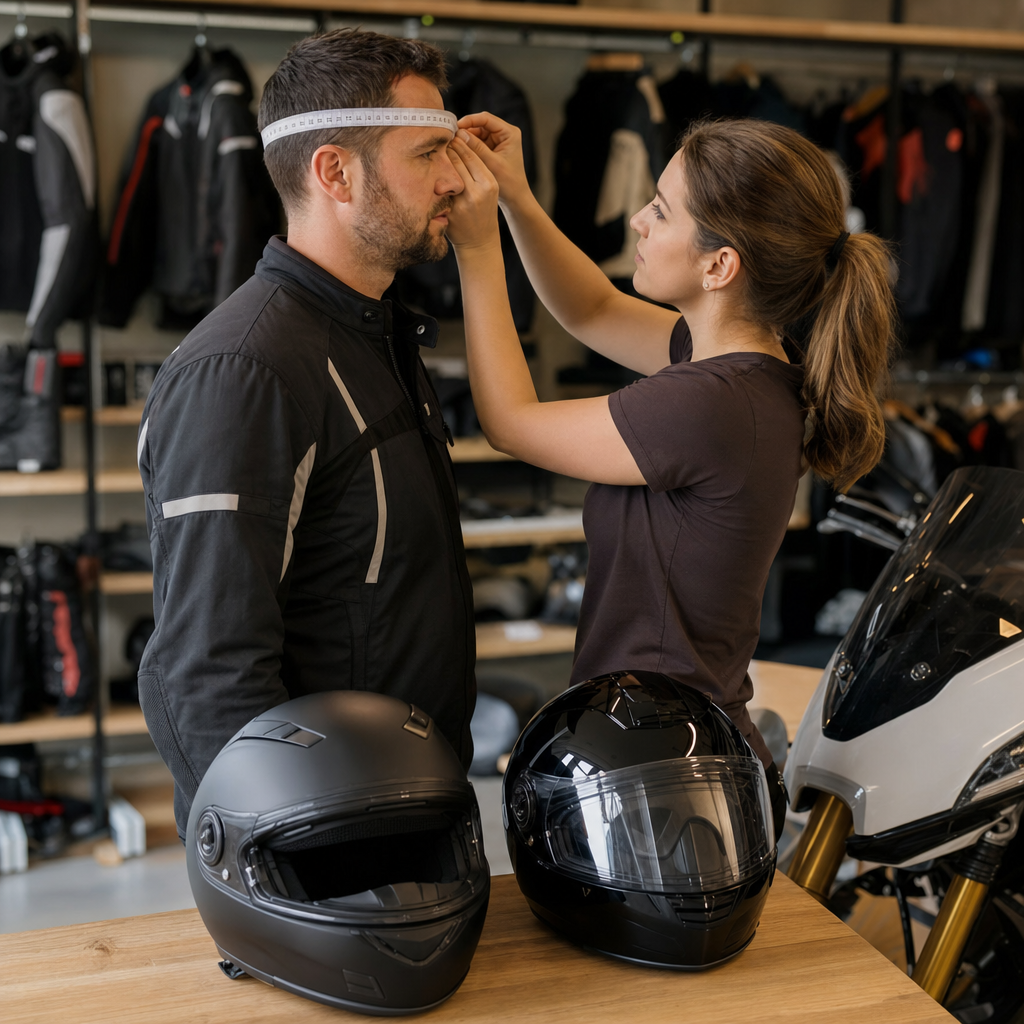
Head size and shape: how to measure for a helmet and recognise a good fit
Type approval is entry to the selection, not a guarantee of a good purchase. Only trying it on will show whether a particular helmet stays stable on your head. Treat motorcycle helmet size as a combination of circumference, head shape and what happens after tightening the strap.
Measure your head circumference. If you are wondering how to measure motorcycle helmet size, use a tailor’s tape measure. Run it roughly above your eyebrows, over your ears and around the widest part at the back of your head. The tape should rest against the head, not dig in. Repeat the measurement and note the consistent value in centimetres.
Compare the size chart for the specific model. Do not assume that an M from one brand fits the same as an M elsewhere. Manufacturers use different shells, linings and size ranges, so check the details for the particular model rather than relying only on the universal S, M or L label.
Assess the shape, not just the number. Two helmets in the same size can fit very differently across the forehead, temples and cheeks. Mild, even pressure is normal in a new helmet. Sharp localised pressure, pain or pronounced pressure marks are warning signs.
Carry out a quick fit test. When a motorcycle helmet is fitted correctly, the cheek pads should hold your face, the strap should be tightened and your view should remain natural. Try gently twisting the helmet and pulling it backwards or upwards. If it moves or comes off easily, it is too loose.
A typical situation: your measurement falls between M and L. Do not automatically put the larger helmet on your shortlist “for comfort”. First check the size chart for the specific model, then when trying it on see whether the smaller size creates localised pressure and whether the larger one remains stable after the strap is tightened.
If you wear glasses, have longer hair or plan to use an intercom, also check the space at the temples, glasses channels, room for speakers and whether anything changes the helmet’s position on your head. Once the size and fit are right, the next step is to compare features with direct safety importance.
Safety features that take priority over extras
Once the helmet stays stable, look at the aspects with direct safety importance in use. It is not only about the material in the description, but the whole package: construction, fastening, visibility and whether important parts can also be dealt with later according to the product information.
Shell and impact-absorbing liner: in the product description, check the shell construction, number of shell sizes, type of internal impact-absorbing layer and stated safety solutions. Do not make a simple ranking that “material A is always better than material B”. The helmet’s overall design, standard and fit are what matter.
Fastening: the strap must tighten reliably, stay under the chin and not loosen by itself. Both double D-rings and micrometric fastenings only make sense if you can fasten them correctly for every ride.
Stability on the head: helmet safety features work best when the helmet does not float about or rotate, and the cheek pads hold the face without sharp pressure.
Visibility and visor: compare the width of the field of view, visor optical clarity, the manufacturer’s stated scratch-resistance information and whether the visor can be replaced after wear or damage.
Spare parts: for shortlisted models, check whether the product information lists replacement visors, cheek pads, mechanisms, seals or Pinlock inserts. For longer-term use, it is important to know what can be addressed by replacement according to the manufacturer’s information.
If two helmets pass type approval, sizing and these safety criteria, only then does it make sense to consider comfort differences for your riding.
Comfort and features for your riding: what is worth comparing afterwards
Among helmets that have already passed the standard, fit and safety priorities, comfort starts to decide. Do not look for the longest feature list. Look for equipment that suits your riding.
Ventilation: look at the number of vents, their placement and whether they can be operated while wearing gloves. Effectiveness also depends on riding position, motorcycle type, the motorcycle windscreen and speed, so do not treat it as an isolated figure.
Weight: on longer tours or brisk rides, it may affect neck fatigue. Compare it using the details for the particular model, not an impression of the category.
Noise level: is highly subjective. It changes with rider height, the motorcycle’s aerodynamics, head position and the seal around the neck and visor.
Sun visor, Pinlock and visor: a motorcycle helmet with Pinlock or anti-fog preparation is particularly useful for commuting, cooler weather and riding in the rain. A sun visor is practical for touring, but still check the quality of the view through the main visor.
Glasses and intercom: if you ride with prescription glasses or plan to use a communicator, look for glasses recesses, room for speakers and compatibility according to the specific helmet’s description.
Maintenance and parts: a removable lining, replacement visor, seals or Pinlock inserts are practical criteria for long-term use.
A touring rider will often value a sun visor, good ventilation, lower noise and intercom preparation more than someone riding short urban journeys. With a flip-up helmet, the advantages and disadvantages are most apparent in its weight and operation of the mechanism. Comfort is important, but if it overshadows fit, the standard or visibility, it becomes a common beginner’s mistake.
The most common mistakes when choosing your first motorcycle helmet
Extras are useful, but they often draw beginners into the wrong order of decisions. Especially when shopping online, it is worth pausing if the choice rests on one appealing detail instead of riding type, standard and fit.
Choosing by appearance, brand or special offer. An attractive motorcycle helmet may still not suit your use. First check the type, type approval, size and details for the specific model.
A size that is too loose “for comfort”. A helmet should not cause painful pressure, but it should not move independently of your head either. Correctly fitting a motorcycle helmet means firm contact, a tightened strap and stability when you move your head.
Ignoring head shape. The same circumference in centimetres does not mean the same fit. One shell may press on the forehead, another on the temples or cheeks.
Mistaking extras for safety. A sun visor, intercom, colour or design cannot replace a good fit, reliable fastening, visibility and a verifiable standard.
No maintenance and replacement-parts plan. In the event of damage, a severe impact, or a worn strap, lining or visor, do not focus only on cosmetics. If you are wondering when to replace a motorcycle helmet, follow the helmet’s condition and the manufacturer’s recommendations.
If you find one of these weaknesses in a model, do not compensate for it with another feature. Instead, rule it out or put it through your final checklist.
Pre-purchase checklist: how to create a shortlist in a comparison tool
The simplest way to choose a motorcycle helmet without taking a shortcut through design or one feature is to put every model through the same checklist. If it fails an essential item, leave it off your shortlist.
Riding scenario: I know whether I need a helmet for brisk road riding, touring, town riding, a scooter or riding off surfaced roads.
Helmet type: the category suits the use – for example, full-face for faster road riding, flip-up for practical touring or open-face mainly for more relaxed urban trips.
Type approval: the motorcycle helmet type approval can be traced on the label, strap, inside the helmet or in the product information.
Size: I have measured my head circumference and compare the motorcycle helmet size with the size chart for the specific model, not just the general S, M or L marking.
Fit: the helmet fits firmly, does not move independently, the strap holds under the chin and no sharp pressure points occur.
Safety priorities: I compare construction, fastening, visibility, visor and replacement parts using the product data.
Features for my riding: only then do I consider ventilation, weight, sun visor, Pinlock or anti-fog preparation, glasses and intercom.
A practical shortlist can contain, for example, 3 to 5 models of the same or similar type, for which the standard, size, likelihood of a good fit and features you will genuinely use have been checked.
In a comparison tool, it makes sense to start with filters for type, size, type approval and features, then compare product information side by side for each model. A good final choice is not the one with a single most appealing specification, but the one that has passed the riding scenario, standard, fit and practical-features checks.