

One hypothetical product listing highlights greater thickness, another the surface type and lower weight. Which shortcoming would bother you most from your first sessions: pressure on your knees, slipping, uncertainty in poses, carrying it, or demanding care? The answer determines the first branch of the decision tree. Rather than comparing everything at once, you can rule out mats that do not address your main issue and assess the remaining options according to acceptable compromises.
Start with one filter: what would disrupt your practice most?
Use your answer from the introduction as the first filter. Rather than adding up benefits, choose the shortcoming that would make you change position, interrupt your practice or leave the mat at home:
- uncomfortable pressure when kneeling and in floor poses,
- hands or feet slipping on the surface,
- a yielding, unstable feeling in stable poses,
- impractical carrying to the studio or when travelling,
- care that you do not want or do not have time to deal with after a regular practice.
The dominant issue is not a list of everything a yoga mat should handle. It is the one characteristic on which you do not want to make a major compromise. You can rule out options that clearly fail to meet it. For now, treat the other parameters as secondary, not automatically better or worse.
If two issues matter equally, prioritise the one that affects more of your usual practice. Keep the other as a follow-up check. For a beginner most troubled by pressure in kneeling poses, comfort and support form the first filter, while low weight remains a secondary requirement. Their first branch will be thickness assessed alongside support.
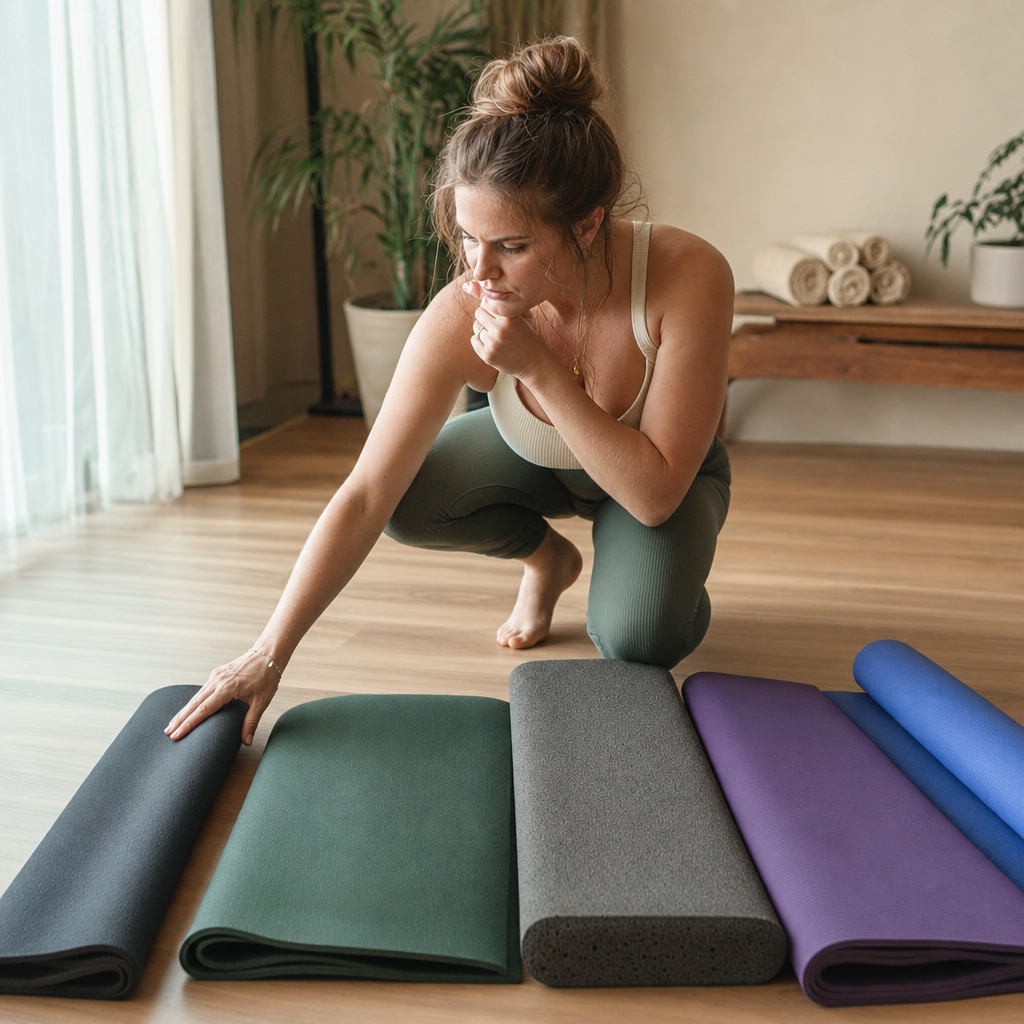
If pressure on sensitive areas is a problem, compare thickness alongside support
For kneeling and floor poses, first note the thickness given in the product listing. It is a comparable figure, not a verdict on comfort: the number alone does not show how the mat behaves under load, and greater thickness does not automatically mean better support.
Compare two hypothetical options. The first has a greater stated thickness, but the listing says nothing about firmness or how yielding it is. The second is thinner, but the manufacturer describes its construction as firmer. These details do not allow either to be declared more comfortable. The first lacks decisive information, while for the second you at least know the construction described by the manufacturer.
If you are looking for a yoga mat for sensitive knees, the aim is not the highest possible number or a health or preventative effect. Look for a combination of thickness and support where pressure when kneeling and at other repeated contact points is subjectively acceptable. At the same time, check that the base does not yield more than you are willing to tolerate in stable poses.
If the listing does not describe behaviour under load, do not infer it from thickness or the material name. Note “needs checking” — in the manufacturer’s detailed documentation or, where possible, through hands-on testing. Once the remaining options handle pressure acceptably, turn your attention to the movement of your hands and feet on the surface.
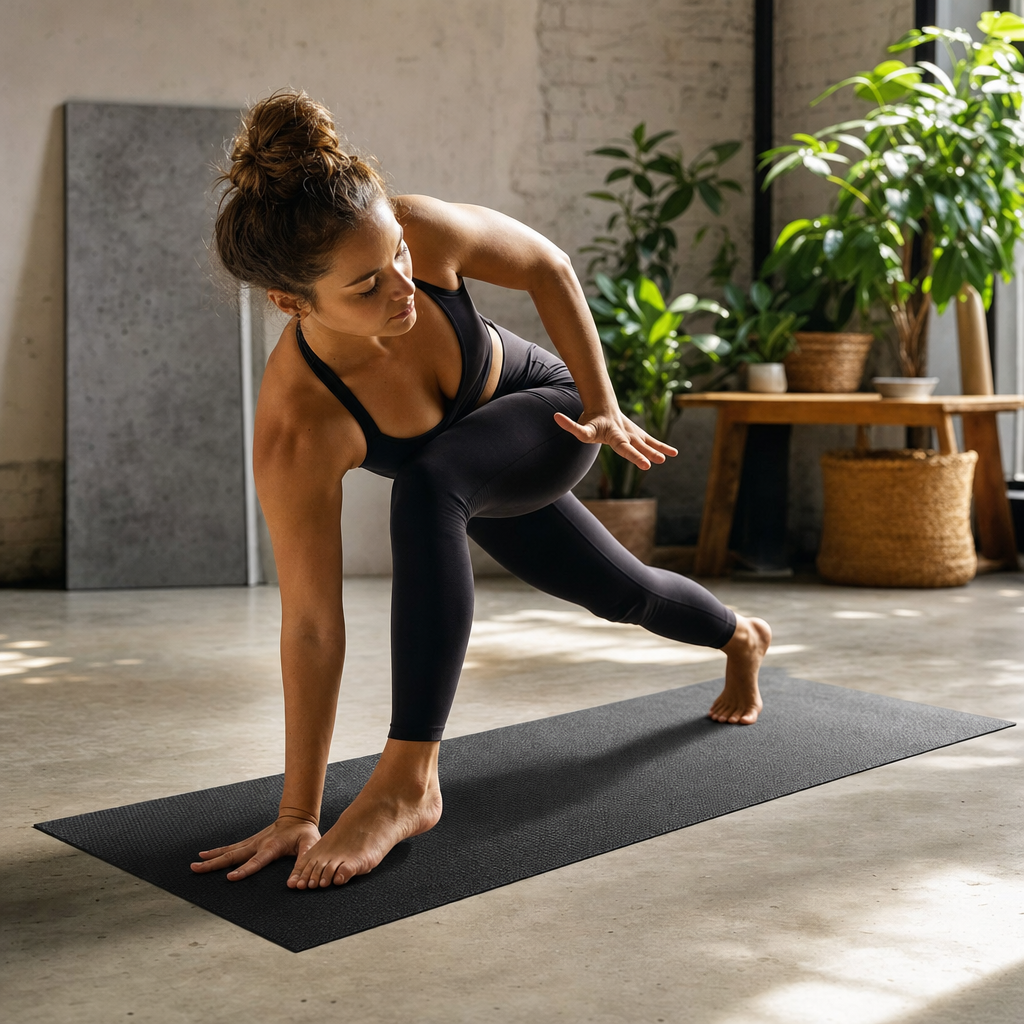
If you are concerned about slipping, separate the surface from the “non-slip” promise
The movement of hands and feet on the surface is a different issue from pressure beneath support points. When comparing, distinguish three levels of information: a visible or verbally described texture, the general label “non-slip”, and a specific manufacturer statement about intended use. Texture is a useful clue, but it does not on its own confirm how the mat will behave in your conditions.
A gentle sequence with dry contact and more dynamic practice involving sweat place different demands on the surface. If you are looking for a yoga mat for dynamic yoga with good grip, check whether the manufacturer explicitly describes how the surface behaves at the relevant intensity, with sweat or in damp conditions. Do not automatically interpret a reference to dry contact alone as reliable grip when damp as well.
- Does the manufacturer mention grip only generally, or also in dry or damp contact?
- Does it state suitability for more dynamic sequences and any restrictions on use?
- Does the description apply to a specific surface, rather than only to the material name or a marketing label?
Copy the exact wording of the claim and its limitations into your comparison. A prominent pattern in a photo shows appearance, not behaviour when sweating. If grip is the main filter and the necessary conditions cannot be checked, mark the mat for further verification or rule it out from your shortlist. However, if your hands or feet do not slide but the base still feels unstable, its yielding nature may be the cause.
If instability is the issue, distinguish softness from firm contact with the floor
If your foot stays in the same place but the mat noticeably yields beneath it, the primary issue is not insufficient grip. In a balance pose, the support point does not move across the surface. Instead, it seems to sink or shift slightly. This feeling is what distinguishes a stability issue from slipping.
When deciding whether a yoga mat should be soft or firm, do not compare thickness alone. Assess it alongside the description of its construction and firmness, because two mats of similar thickness may not feel the same under support. If the product listing does not state how yielding it is, mark it for hands-on verification. Do not estimate it from the material name.
- A softer feel may make sense if floor poses predominate and comfort matters more to you than the firmest possible contact with the floor. However, the yielding feel must not disturb you in standing and balance poses.
- Firmer contact with the floor is preferable if uncertainty in standing or balance poses disrupts your practice more than pressure when kneeling. Here, stability does not mean the hardest option, but acceptably firm and predictable contact with the floor.
Once you are clear about how the mat behaves during poses, the practical side of use comes next: carrying and packing.
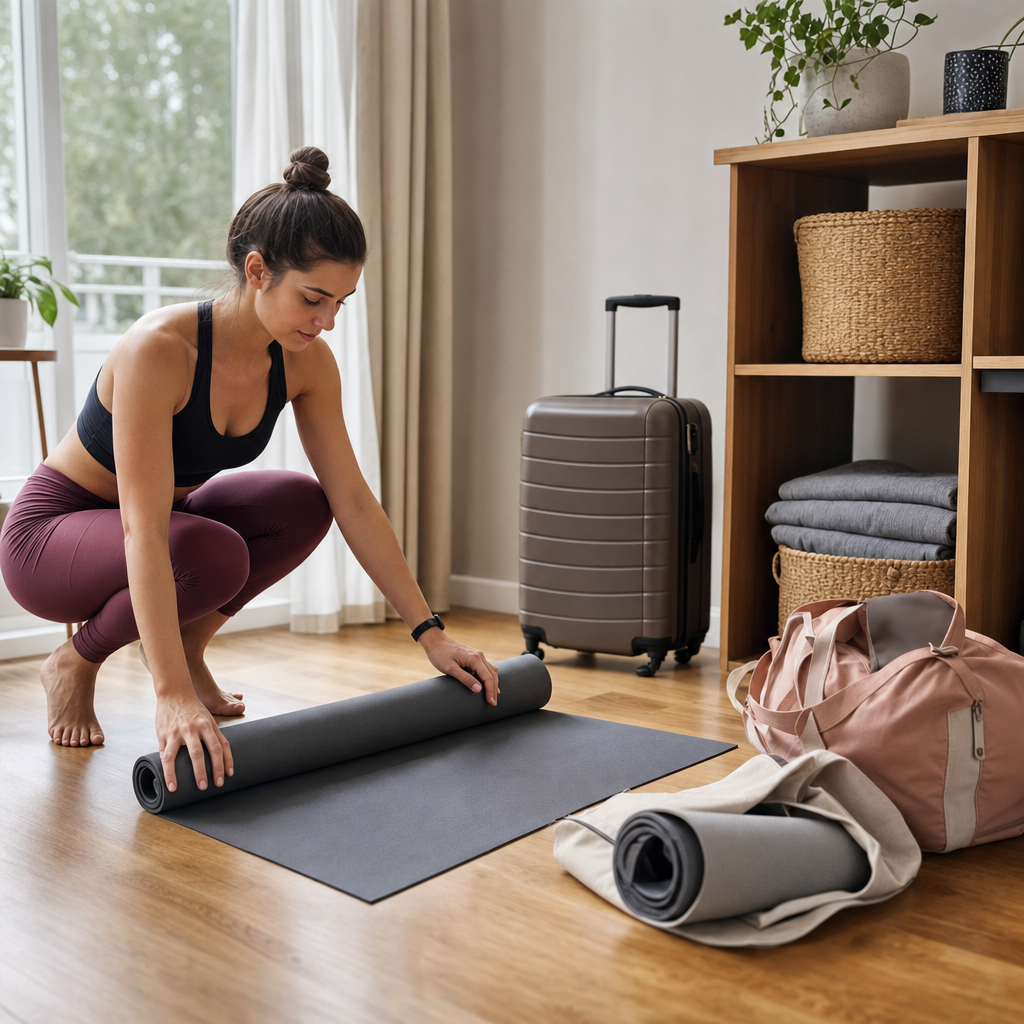
If you carry your mat often, consider both its weight and packed dimensions
When handling a mat before and after practice, familiar parameters take on a different meaning. First check the dimensions of the unrolled mat. Compare its length and width with your body, usual poses and available space. A smaller pack will not help if the surface area is not sufficient for your practice.
The same mat may work out differently in three situations:
- At home: if it remains unrolled or stored in one place, usable surface area and storage-space requirements matter more. Weight may be secondary.
- Studio: when carrying it regularly, consider weight according to the length of your journey, the dimensions of the rolled pack, and the packing and carrying method permitted by the manufacturer.
- Travel: a lightweight yoga mat for travel only makes sense if it fits in your luggage and can be folded or rolled in the way specified by the manufacturer. If packed-mat dimensions are stated, check whether they include the case or strap you plan to use.
Do not confuse packed dimensions with the length and width of the unrolled surface. If the product listing does not provide them, do not judge travel suitability from the product name alone. Portability is determined by the combination of sufficient surface area, weight, packed volume and the permitted packing method. None of these characteristics can be reliably predicted from the material name alone.
Treat material as a clue, not a guarantee of properties
Do not read a yoga mat’s material as a complete summary of its properties. One label may refer to the entire mat, only the core or the top layer. Distinguish these only when the manufacturer specifically states the construction. For a multi-layer mat, the description of the surface or core may matter more to your main issue than the general material name.
Two hypothetical mats, A and B, may have the same general material label. For A, however, the manufacturer describes a textured surface, higher weight and one permitted care method. For B, it states a different surface finish, lower weight and different cleaning restrictions. The shared name is only a starting point, not a reason to assign them the same grip, comfort or durability.
To make yoga-mat materials and their differences genuinely comparable, add four details to each name:
- the surface and construction declared by the manufacturer,
- whether it has one or more layers,
- the stated weight,
- the permitted care method.
When deciding, use only the consequence relevant to your dominant issue. A material ranking such as “this one always grips better” or “that one is automatically softer” would confuse a label with a property of a specific product. Likewise, do not treat vague environmental claims as verified facts without a precise explanation from the manufacturer. Practical differences between constructions often only become apparent in care instructions.
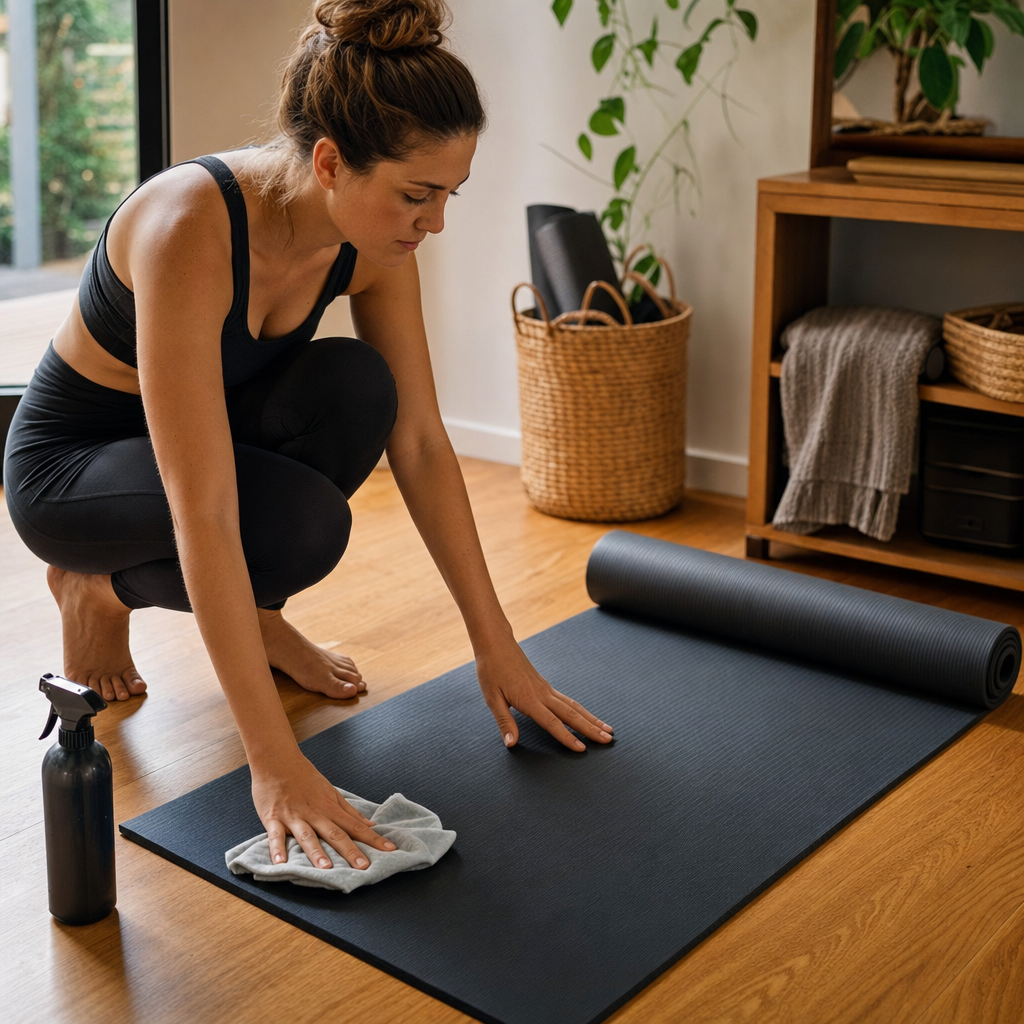
If you do not want complicated maintenance, read the manufacturer’s instructions first
The instructions for the specific product reveal the practical demands of a particular construction. When caring for a yoga mat, therefore, do not look for one formula for all materials. Compare three sections in the product listing or manual:
- Cleaning: Find out which routine cleaning method the manufacturer permits and whether it states restrictions on water, cleaning products or mechanical cleaning. Do not use general advice from the internet in place of these instructions.
- Drying: Check how the mat should dry and under what conditions it can be rolled, folded or stored again. If the documentation states when it is ready to be packed, follow this guidance.
- Storage: Check whether it should be rolled or may be folded, and what location the manufacturer recommends. Treat temperature, sunlight or humidity as restrictions only if the documentation actually mentions them.
Imagine carrying the mat home after visiting a studio. If the instructions require a drying method for which you do not have suitable conditions either on the journey or at home, maintenance will not be practical for your routine, even if the other parameters are suitable. Make the same check for home practice and travel.
If instructions are missing or unclear, do not make assumptions about cleaning a yoga mat. Mark maintenance as an unresolved question, and only then compare the results of all branches side by side.
Shortlist: one main issue, two compromises, one final check
Create one comparison table from the results of all branches. Put one mat in each row and the consistent data from the product listing in the columns: thickness, dimensions, weight, material, construction and surface description. Add the decision outcome alongside them.
- One main issue: Rule out every option that does not meet your dominant filter. If information decisive for comfort, grip, stability, portability or maintenance is missing, do not add an estimate or extra points. Record the status as “needs checking”.
- Two acceptable compromises: Choose two secondary characteristics on which you are willing to compromise, such as higher weight and more demanding storage. Compare them only among mats that passed the first filter.
- One final check: In the manufacturer’s instructions, confirm the intended use and, according to your filter, information on sweating or dynamic practice, cleaning, drying, storage and the permitted packing method.
A hypothetical comparison of three anonymous options may look like this:
Option | Main filter | Compromise 1 | Compromise 2 |
|---|---|---|---|
A | Meets main filter | Acceptable compromise | Needs checking |
B | Does not meet it – rule out | – | – |
C | Meets main filter | Acceptable compromise | Acceptable compromise |
If the relevant category is available on Zoneo, use it to compare the stated parameters, not as a universal ranking of suitability. Only when viewing a specific offer in a partner shop should you check changing details: the current price, availability, delivery, order terms and seller information.
The result of the 1–2–1 rule is a comparable shortlist, not an apparent universal winner. First resolve the issue that would disrupt your practice most, then accept two conscious compromises, and finally verify everything the product listing does not itself confirm.