
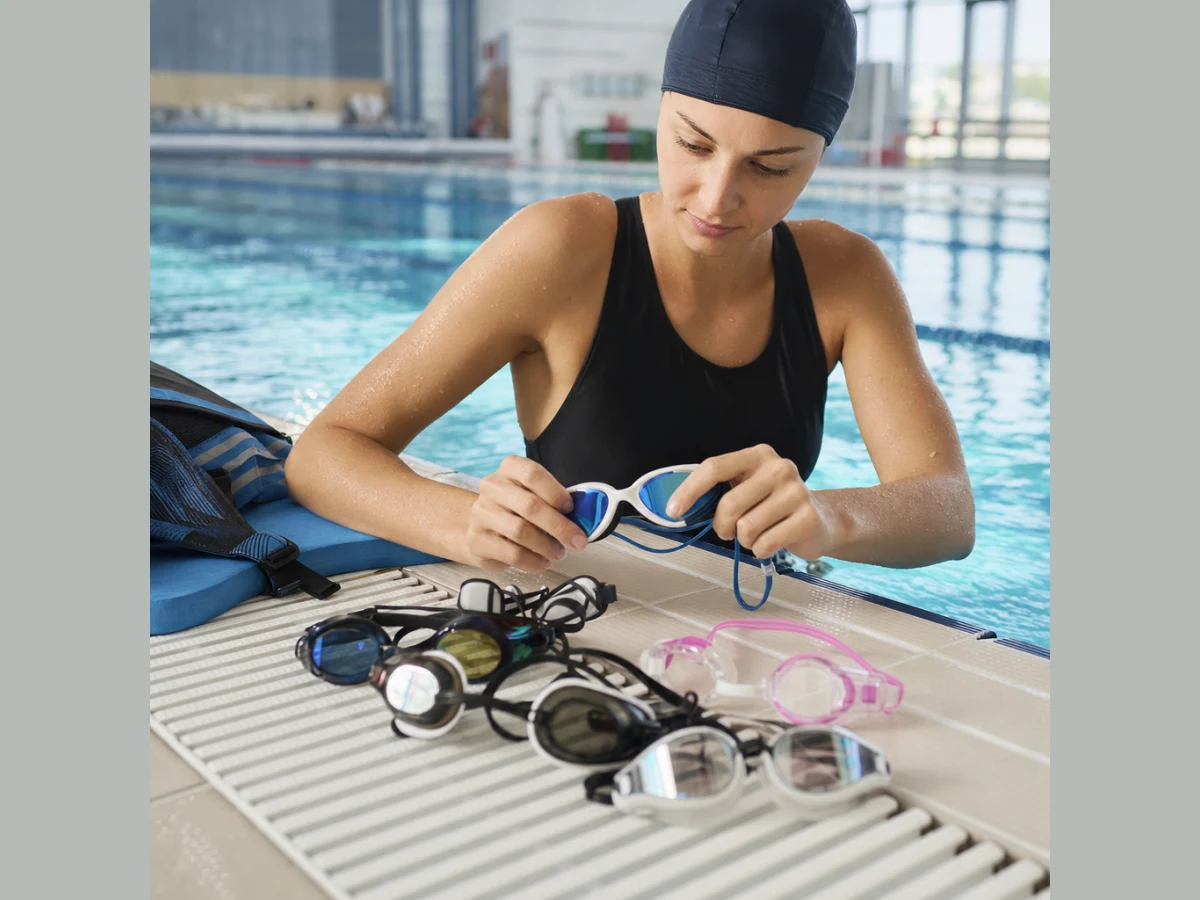
With swimming goggles, frame colour matters less than how they fit your face. The seal, adjustability, field of view, lens type for the light conditions and realistic expectations of anti-fog treatment are important. If you establish before buying whether you mainly swim in a pool, train or swim outdoors, it is easier to rule out models that would pinch, leak or fog up quickly.
First, clarify how you will use them: pool, training, child or open water
When considering how to choose swimming goggles, start with how you will use them. A model for relaxed pool lengths, regular training, children’s lessons or open water involves a different compromise. The best swimming goggles for you are not universal. They suit the setting, how often you swim and the sensitivity of your face.
Leisure swimming in an indoor pool: for occasional or regular fitness swimming, look for pool goggles with soft contact around the eyes, easy strap adjustment and clear or lightly tinted lenses according to the lighting.
Regular training: for repeated lengths, turns and a faster pace, look for stability on the face, a secure seal and a sensible balance between a more compact shape and comfort. Training goggles do not need to be the hardest, but they should not shift during a stroke or after pushing off the wall.
Sensitive skin around the eyes: the priority is a softer or wider seal, evenly distributed pressure and adjustment without overtightening. If you feel sharp pressure at the nose or below the eyes when trying them on, the strap alone will not solve it in the water.
Children’s swimming: choose children’s swimming goggles first according to their smaller size, softness and quick adjustment. For lessons, play or jumping in, stability matters, but not at the cost of an uncomfortably tight strap.
Open water and outdoor swimming: for goggles for the pool and open water, look for a wider field of view, lenses suited to brighter light, UV protection and possible glare reduction. Outdoors, spatial orientation matters more than when swimming calmly in one lane.
Example: if you go to an indoor pool twice a week and have sensitive skin around your eyes, do not start with a low-profile racing model simply because it looks ‘professional’. First look for comfort, adjustability and lenses suited to pool lighting.
This quickly separates models that make sense for your swimming from those that only look good in a picture. Only then is it worth looking at the details: start with the seal and frame shape, as these most often determine whether goggles leak or pinch.
Seal and frame: why goggles should not simply be ‘as tight as possible’
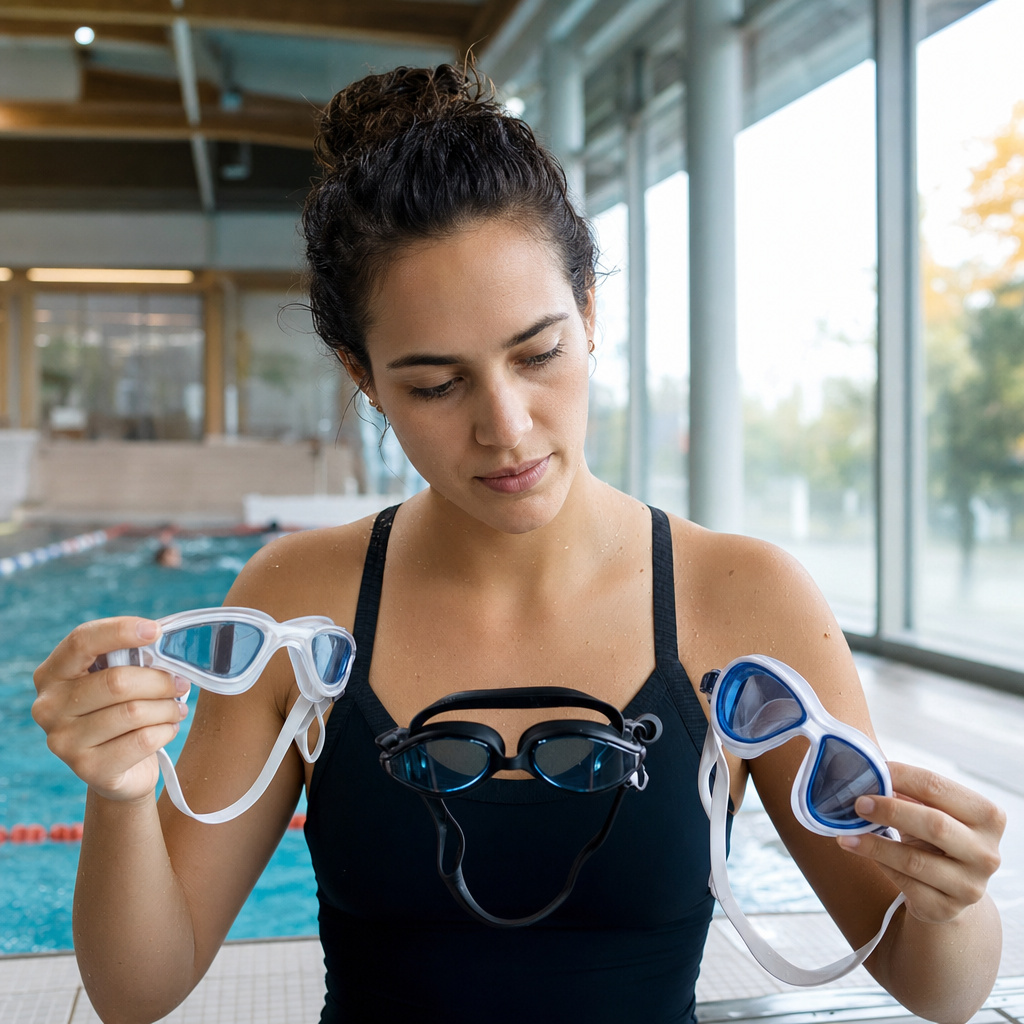
After the initial selection comes a feature that cannot be replaced by tightening the strap further. The goggle seal should naturally follow the area around the eye socket so that water does not get inside and the strap does not need to pull the goggles into your face.
Soft comfort seal is particularly suitable for recreational swimmers and people whose goggles easily leave pressure marks. It better accommodates small differences in face shape and usually feels more pleasant during longer periods in the water.
Low-profile or racing shape sits closer to the eyes and may feel more stable during intensive swimming. The trade-off may be less of a sense of space and greater sensitivity to precise positioning around the eyes.
Wider recreational frame often offers more comfortable contact with the face and a more open view, but may feel bulky or fit less well on a narrower face.
The difference between a soft and firm seal therefore does not automatically mean ‘beginner versus advanced’. A soft seal is not less valuable simply because it is more comfortable. Conversely, an overly hard or narrow seal may feel more ‘professional’ at first touch, but if it presses at the nose, beneath the eyes or at the outer edge of the eye socket, it quickly becomes a problem while swimming.
If the goggles do not seal without extremely tightening the strap, the problem is more likely an unsuitable frame or seal shape than insufficient tightening.
When reading a product page, translate descriptions into practical terms. The phrase ‘soft silicone seal’ suggests a model that may suit a recreational swimmer or someone seeking swimming goggles for sensitive skin around the eyes. In contrast, ‘low-profile racing shape’ is more likely to describe goggles that sit closer to the face and are more suitable for faster swimming, where stability and compactness take priority over maximum comfort.
When comparing models, look for terms such as soft silicone seal, low profile, recreational or training shape, children’s or junior fit, and references to adjustability. Swimming goggles with a good seal settle naturally on the face. Only then does it make sense to consider the nose bridge, strap and exact pressure distribution.
How to check they will fit: nose bridge, strap and pressure around the eyes
When the shape looks suitable, check that it can be positioned without pain. Even a good seal can fail if the goggles sit too narrowly at the nose or the strap pulls them into your face. The aim is not a suction effect at any cost, but even contact around both eyes.
Check the nose bridge. A fixed nose bridge offers the fewest adjustment options, so it must fit straight away. An interchangeable or adjustable nose bridge gives more scope for narrower or wider eye spacing. If it does not fit, the lenses may press at the nose or separate at the inner corners.
Tighten the strap in small increments. It should stabilise the goggles, not compensate for a poorly fitting shape. Start looser, tighten gradually and stop before the pressure becomes uncomfortable. If pool goggles keep leaking in the same place, tightening them further is usually not the solution.
Watch how pressure is distributed. It should not be sharp at the nose, beneath the eyes or on the outer edges of the eye sockets. Goggles with a good seal may leave a slight mark, but should not cause stinging, throbbing pressure or the need for constant repositioning.
A simple preliminary test before getting in the water is to hold the goggles against your face without the strap on, press them lightly and see whether they sit evenly. This does not guarantee zero leakage, but it helps quickly identify an obviously unsuitable shape.
Before your first swim, adjust the nose bridge, tighten the strap only in small steps, swim a few lengths and then fine-tune gently. Warning signs are clear: water always gets in at the same point, the lenses touch your eyelashes, the frame presses on your nose or the strap has to be tightened uncomfortably.
When comparing online, check nose-bridge adjustability, strap type, intended size and whether it is a model for adults, juniors or children. Once you know how to adjust swimming goggles without pressure, the next question is what view they offer while swimming.
Field of view: when a compact view is enough and when you want peripheral vision
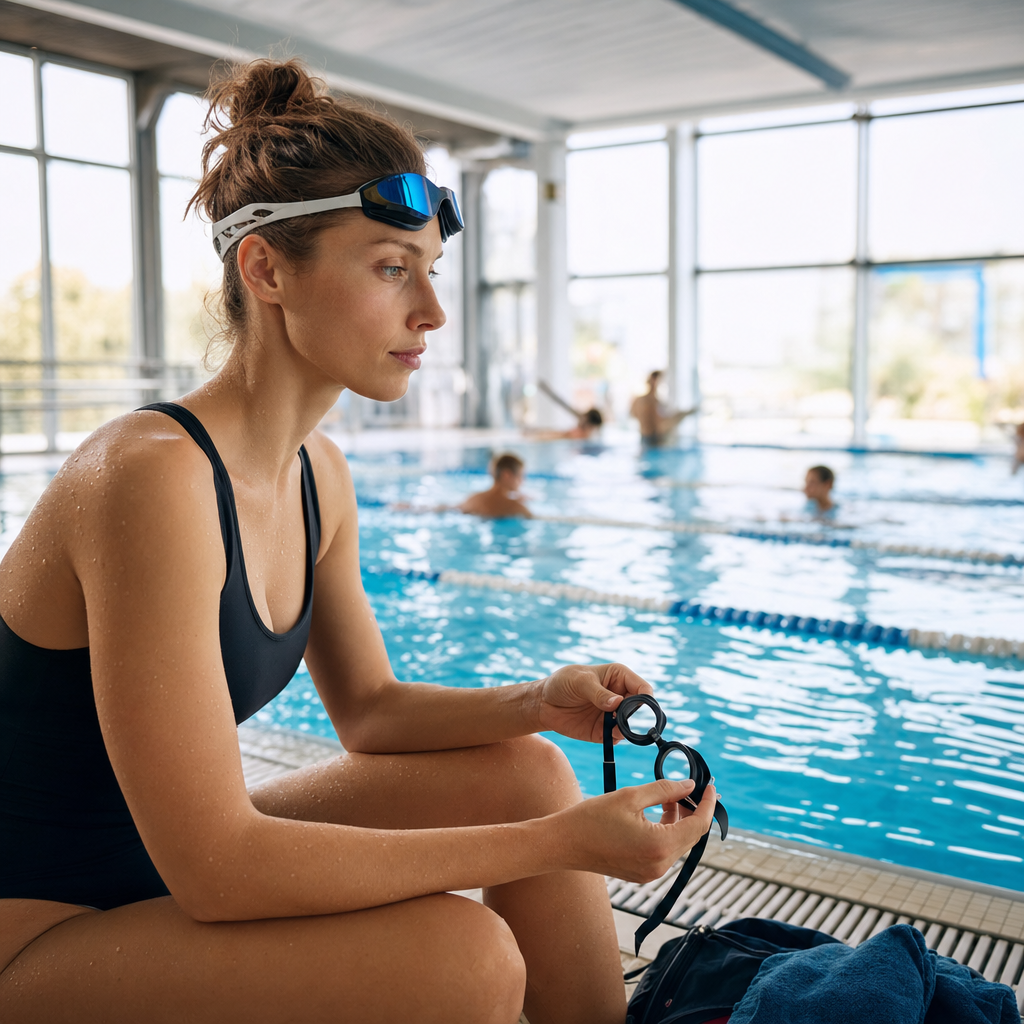
Goggles that fit well must also offer a view suited to your swimming. Do not choose the field of view of swimming goggles by the rule ‘the wider, the better’, but by how much orientation in the water you really need.
Lane training: for regular lengths, a more compact forward and downward view is often enough. The swimmer mainly follows the line on the pool floor, the turn and stroke rhythm. A smaller, closer-fitting shape can feel stable and less distracting, particularly at a faster pace.
A recreational pool with more people: a wider side view helps you notice the pool edge, the neighbouring lane and other swimmers’ movements. If you often swim outside a dedicated lane or alternate strokes, a wide field of view may be more practical than a very narrow training shape.
Open water: peripheral vision matters more because you navigate using the shore, buoys, other swimmers and the overall surroundings. Larger lenses or a wider frame may feel more pleasant here if they also fit your face well.
The compromise lies in the size. Larger lenses and a curved shape may improve the sense of visibility, but they may not suit every face and can feel less compact than training goggles. On product pages, therefore, look for wording such as wide field of view, peripheral vision or curved lenses, but do not automatically treat it as the universally best option.
Once you know how wide a view you need, the second part of visual quality remains: how the lenses behave in particular light conditions.
Choose lenses by the light: clear, tinted, mirrored or polarised
A wide field of view only helps when you can read your surroundings clearly through the lenses. Lenses that are too dark in a dim pool unnecessarily reduce contrast, while clear lenses in strong sunshine may feel uncomfortable. Choose swimming-goggle lenses as a light filter, not as a colourful accessory for the frame.
Clear lenses are particularly practical for indoor pools, dimly lit spaces or evening swimming. They do not darken the image, making it easier to orient yourself by the line on the floor, the pool edge and movement ahead of you.
Tinted lenses make sense in brighter lighting or when you alternate between an indoor pool and outdoor swimming. They are a compromise, but may feel too dark in a darker pool, especially if you want the most natural view possible.
Mirrored lenses are most suitable for brighter light and outdoor swimming, where they help reduce the sensation of glare. However, they may not be necessary for a standard indoor pool if you would use this feature only occasionally.
Polarised lenses are an option for outdoor swimming, especially if reflections from the water surface bother you. Do not assume they are standard on every model – check this feature directly on the product page.
A typical difference: a swimmer who goes to an indoor pool after work will probably be happier with clear or only lightly tinted lenses. For summer outdoor swimming, tinted, mirrored or polarised lenses may be more pleasant, especially if the product also states UV protection. Check this separately for outdoor swimming. It cannot be reliably inferred only from lens colour or a mirrored appearance.
If you are looking for one pair of swimming goggles for the pool and open water, start with the environment where you will swim most often. There is no universally best lens colour – it is always a compromise between light, reflections and how naturally you want to see the water around you. Once you have chosen the lens type, one practical question remains: whether they will stay clear while swimming without unpleasant fogging.
Anti-fog helps, but it is not indestructible: how to reduce fogging
Even well-chosen lenses lose their purpose if they fog up after a few minutes so that you cannot see the line on the pool floor or the pool edge. Treat anti-fog labelling as a helpful lens feature: it reduces fogging, but does not mean the goggles will never fog up or that they do not need careful handling.
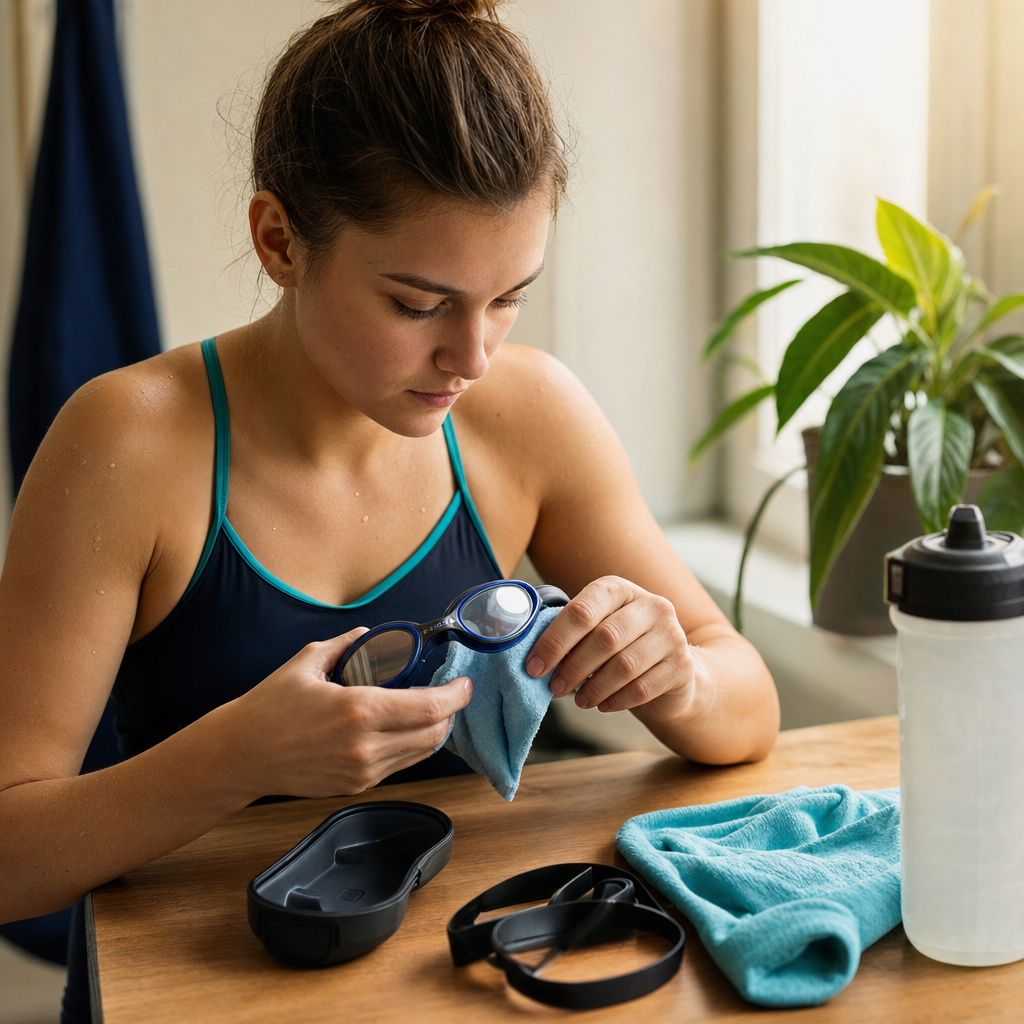
Do not rub the inside of the lenses. Fingers, a towel or harsh cleaning can damage the coating intended to reduce fogging. Unless the manufacturer states otherwise, gently rinse the inside of the lenses only.
Rinse them with clean water after swimming. Residues of pool or salt water, cosmetics or dirt can reduce comfort in use. Then allow the goggles to dry according to the manufacturer’s instructions, not on a hot radiator or in direct sunlight.
Protect the lenses during transport. Tossed loose into a bag with swimwear, a bottle and a towel, they can become scratched. A case or separate pouch helps protect the inside of the lenses in particular.
If new anti-fog swimming goggles start fogging quickly after a few visits to the pool, do not immediately label them a bad model. Check whether you cleaned the inside lenses by rubbing, whether water remains in the goggles and whether the seal still sits evenly. Water inside, an overly loose fit or a leak at the nose can make the feeling of fogging worse.
Use anti-fog products carefully and only if they are suitable for the lenses concerned and the manufacturer does not exclude their use. When comparing in the catalogue, treat anti-fog as an important factor when choosing goggles to prevent lens fogging, not as an absolute promise of maintenance-free use. With children’s models, practicality is even more important: the goggles must cope with quick fitting and less careful handling.
Children’s swimming goggles: comfort and easy adjustment come first
For children, the criteria shift even more towards comfort and simplicity. It is not enough to take a smaller adult model and tighten the strap to the limit. A child’s face has different proportions and children quickly notice uncomfortable pressure, so look on the product page for children’s or junior sizing, a soft seal and easy adjustment.
Imagine a child at swimming lessons: a parent needs to put the goggles on quickly before the class, adjust them gently during a break and not have to deal after a few lengths with complaints that they press on the nose or beneath the eyes. Children’s swimming goggles with a softer frame and a strap that adjusts without lengthy threading or forceful pulling are more practical here.
The frame should sit evenly on a child’s face, not only on two painful points.
The seal should feel soft and should not require uncomfortable tightening to stop the goggles leaking.
The strap should be quick to adjust even with wet hands.
The goggles should stay in place during jumping, play and sudden movement, but without extreme tightening.
The child should be able to see the pool surroundings well through the lenses and not feel confined in them.
A colour or favourite design can help make a child want to wear the goggles. However, it should not outweigh size, softness and ease of use. If a child takes off their pool goggles after a few minutes or constantly moves them, the problem is often not reluctance but that the model does not fit. In further comparisons, therefore, take these signals as seriously as lens specifications or anti-fog treatment.
How to narrow your Zoneo choice to a few suitable models
Once you know what the goggles need to meet, transfer the criteria to filters and product pages. First rule out models with unsuitable uses or features. Consider price, brand or frame colour only after this step.
Start with the user and setting. Separate adult and children’s models, goggles for the pool, training and recreation, and possibly outdoor or open-water swimming, if this information is given in the catalogue.
Check comfort features. For each candidate, compare the type of seal and frame, nose-bridge or strap adjustability, intended size and references to a wider field of view.
Choose lenses for the light you encounter most often. For an indoor pool, look for lenses suited to lower light. For outdoor swimming, place greater emphasis on swimming goggles with UV protection and glare reduction, if these features are stated for the product.
Check practical treatments. Treat anti-fog labelling as an important feature, but compare anti-fog swimming goggles together with care requirements, shape and fit.
Instead of choosing one model immediately, make a shortlist of 2 to 4 options. It might look like this:
a comfortable model for an indoor pool with a softer seal and lighter lenses,
a more stable training model with a secure seal and easy strap fine-tuning,
a model for outdoor swimming with a wider view, UV protection or lenses suited to reducing glare.
This means the question of how to choose swimming goggles does not become a search for a universal winner. The best swimming goggles for you are those that first suit the use, then your face shape, the light and care requirements. Only from such a narrowed selection does it make sense to compare offers for specific products in the Zoneo catalogue.