

A racket may look light on paper, yet a head-heavy balance can tire your arm. Another may support a powerful shot but make control harder with an inconsistent swing. When choosing your first racket, do not start with the highest value or an ‘attacking’ label. Start with the problem you feel most during play: fatigue, a late swing, poor control or lack of power. The following approach will help you turn this symptom into a comparable profile of weight, flexibility, balance and string tension, identify the main trade-off and verify the key details before buying.
Start with what happens in play: which problem takes priority?
When choosing your first racket, do not begin with whether you want to play ‘attacking’ or ‘defensive’. Focus on the symptom that recurs over several rallies and most disrupts a timely, repeatable shot. One poor rally is not enough. Look for a pattern, not an exception.
- Arm fatigue: your arm gradually stiffens or you have to shorten your swing, even though you start out playing comfortably.
- Late swing: you prepare the racket late and contact with the shuttle is repeatedly late.
- Insufficient control: you can complete the swing, but with a similar movement cannot reliably direct the shot where intended.
- Lack of power: contact is usually timely and reasonably consistent, but the shot lacks the required length or pace.
If the problems overlap, prioritise the one that first disrupts a repeatable shot. Fatigue or late contact will therefore usually take precedence over trying to gain more power. Put control first when you can complete the swing but the shot direction remains uncertain. If you are unsure, note which symptom appears first and triggers the others.
For example, a beginner may feel both a lack of power and late contact. Looking for a ‘more powerful’ setup would not solve the underlying timing problem. Write down your priority together with a limit on the trade-off: ‘I need to complete my swing, but I do not want to increase arm fatigue.’ This statement defines what the racket must not make worse, rather than what it will definitely fix. Equipment does not replace technique or court movement. Once you know the problem and the unacceptable consequence, you can assess weight together with where the racket carries its load.
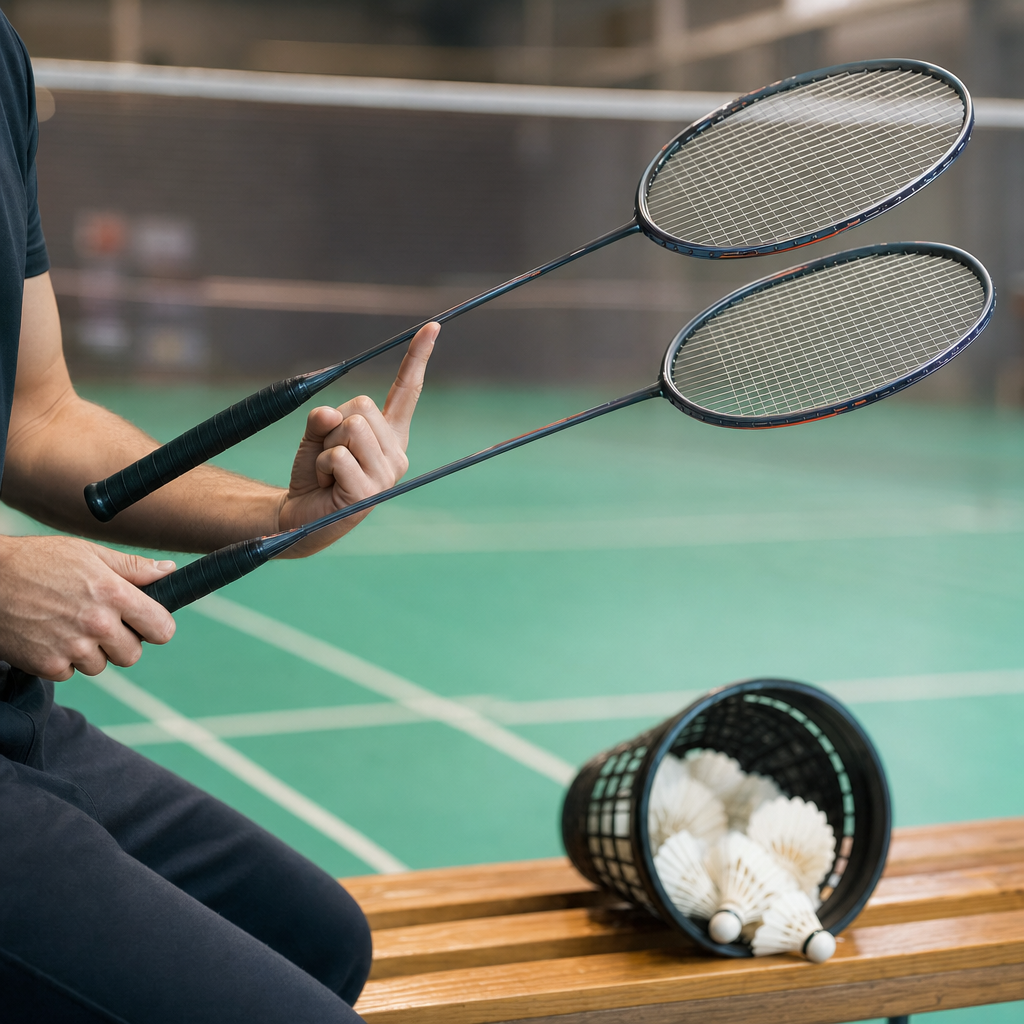
Weight without balance is not enough: assess them as one pair
Weight shows the racket’s overall load, while balance shows where that load is concentrated. A racket can be head-heavy, evenly balanced or head-light. Neither a lower weight nor a particular balance is in itself a sign of quality or suitability for a beginner.
Imagine Racket A and Racket B in the same light weight category. A is more head-heavy, so it may feel more demanding when getting moving and changing direction, while a powerful swing may emphasise support from the racket head’s movement. B is head-light and may feel more manoeuvrable when preparing a shot. Both are labelled ‘light’, but their effect on handling and fatigue may not be the same.
Weight and balance can reinforce each other or partly offset one another:
- A lighter head-heavy racket may not be the quickest to prepare for a swing, because the load in the head can offset some of the benefit of lower weight.
- A lighter evenly balanced racket may offer a more balanced trade-off between handling and the feeling of support through the shot, but is not automatically the best choice.
- A heavier head-light racket may remain relatively manoeuvrable, but the weight distribution does not remove its higher overall load.
With fatigue or a late swing, check whether the balance undermines the expected benefit of a lighter racket. If you are looking for more noticeable support through the shot, do not assess it only by higher overall weight. Load distribution also matters.
On the product page, check the stated weight category, how the weight is specified and the balance designation. Also check whether the information refers to the same racket condition, for example strung or unstrung and without additional accessories. If this is unclear, mark the difference as uncertain rather than filling it in with your own estimate.
This gives you a picture of how the racket handles. The shaft’s and strings’ response to swing speed and consistency completes the overall profile.
Match flexibility and strings to swing consistency, not higher values
Shaft flexibility describes how the shaft behaves during a swing. A more flexible shaft may be more accessible with a less powerful or still inconsistent movement, but may feel less direct to a player with a fast, precisely timed swing. A stiffer shaft is most worth comparing when swing speed and timing are repeatable. It may offer a more direct response, but can magnify a contact error. It is not automatically a sign of a higher standard, quality or guaranteed performance.
When choosing between a flexible and stiff badminton racket, do not judge your best shot but a series of ordinary rallies. If swing speed and the moment of contact vary, a stiffer shaft may emphasise inconsistency rather than solve it. If they are repeatable, you may accept greater timing demands in exchange for a more direct feel.
Compare string tension only within the recommended range for the specific model. A more moderate setting may feel more forgiving with less clean contact. Higher tension may bring a more direct feel, but also increase the demands on contact accuracy. The upper limit only completes the stated range — it is not itself a target value or a sign of racket quality.
For the same beginner, a more flexible shaft with more moderate tension can therefore create a more forgiving starting profile if swing speed and contact point are still changing. The trade-off may be a less direct feel when accelerating the movement. A stiffer shaft with higher tension can increase the demands on both timing and clean contact. It is worth considering only with a fast, repeatable swing and a willingness to accept less tolerance for inaccuracies, not simply because of an ambition to play more powerfully.
For each model, verify three separate details: the stated shaft flexibility, the recommended tension range and whether the racket is supplied strung. If the flexibility designation differs between product pages or the range is missing, do not fill it in from a similar model. Do not assume that an already strung racket has a setting that matches your choice. The delivery format and specific tension must be confirmed for the individual offer.
Once you match this pair to swing consistency, you can combine it with weight and balance into a complete racket profile.
Turn four on-court problems into four racket profiles
Combining both pairs gives you a candidate profile, not a ready-made formula. In every scenario, follow the same order: weight with balance, flexibility according to the swing, and tension within the permitted range. Then identify both the expected benefit and the trade-off. This prevents one favourable detail from masking the rest of the profile.
When your arm stiffens during play
If your arm works without problems at first but stiffens during longer rallies and your swing shortens, start with a lighter, manageable weight category. Pair it with an even balance or a head-light balance. Depending on swing speed, a more flexible to medium shaft and more moderate tension within the racket’s recommended range may suit you.
The expected benefit is more comfortable handling and less need to force the racket through every shot. The trade-off may be a less pronounced feeling of support during a powerful swing. This profile may not suit a player who consciously seeks a noticeably heavier head without fatigue. For a specific model, verify the stated weight category, balance, shaft flexibility and recommended tension range.
When you reach the shuttle late
With a late swing, the aim is to prepare the racket earlier. Look for a manageable weight with an even or head-light balance. The very lightest weight category alone may not decide it. With variable swing speed, a more flexible shaft may make sense; with a livelier, repeatable movement, medium flexibility can also be compared. Keep the strings at a more moderate setting within the permitted range.
Such a profile may make it easier to change direction and set the racket earlier, but the trade-off may be less pronounced support from the head during a shot. It will not automatically help if the delay arises mainly from court movement or a late reaction — a racket will not remove the technical cause. Confirm the model’s weight, balance, flexibility and recommended tension range.
When you complete the swing but lack control
First distinguish between two cases. If contact is early at times and late at others, control is probably limited by uncertain timing. In that case, keep an easily manageable weight, an even or slightly head-light balance, a more flexible to medium shaft, and a more forgiving, moderate string setting. The benefit is a profile that does not add further demands to an inconsistent movement. The trade-off may be a less direct feel at contact.
However, if you prepare the racket in time, your swing speed is repeatable and you still cannot reliably direct the shot, you can compare a manageable weight with an even balance, a medium to stiffer shaft and a slightly firmer string setting within the permitted range. The result may be a more direct response, but at the cost of greater demands on clean contact and precise timing.
The second option may not suit a player with an inconsistent swing. The first may feel insufficiently direct to someone who has already stabilised their movement. For an offer, therefore verify all four stated details, especially the flexibility designation and recommended tension range, which must not be estimated from a similar racket.
When your shot lacks power
This profile is most worth exploring when your arm is not tiring and your swing is not late. As a starting point, compare a manageable weight with a slight head-heavy balance, a more flexible to medium shaft for a slower swing, and more moderate tension within the recommended range. Such a combination may help make better use of the racket’s movement without assuming that the heaviest or stiffest model will solve performance.
The expected benefit is a more pronounced feeling of support when driving the shot. The main trade-off may be slower handling or gradually increasing fatigue, so the profile may not suit a player who already prepares the racket late. Verify the stated weight, balance, flexibility and recommended tension range for the specific model.
Every profile is a working hypothesis. With specific models, you now need to identify combinations in which one parameter recreates the problem you are trying to remove.
Elimination is easier than finding a winner: use stop conditions
Turn the working hypothesis into a filter with two sentences: ‘I need…’ and ‘I will rule out…’. For a late swing, it might read: ‘I need quicker racket preparation. I will rule out a combination that shifts the load significantly towards the head.’ The second sentence protects your priority from an appealing detail on the product page.
Apply the stop condition to both pairs at once. If weight and balance ease the problem but flexibility with the planned tension again increases the demands on uncertain timing, the favourable first pair is not enough. Likewise, a low stated weight does not automatically pass the quick-handling filter if the racket is significantly head-heavy for that player.
- Arm fatigue: reject the promise of more power if it brings a load you have identified as unacceptable.
- Uncertain timing: do not treat a stiff shaft or high tension figure as an automatic route to control.
- Lack of power: do not regard the upper tension value as a measure of performance.
Racket A may have an appealingly flexible shaft, but its weight and balance conflict with the need for quicker preparation. Racket B has no extreme parameter, but both pairs respect the priority. For this player, A should be ruled out. Not because it is generally bad, but because one favourable detail does not rescue a conflicting whole.
An accepted trade-off is a conscious exchange, such as less feeling of support through the shot for more manoeuvrable handling. A stop condition directly threatens the reason for the choice. An ‘attacking’ or ‘defensive’ label is therefore only a guide and does not replace checking the four parameters. After this filter, the remaining models are suitable for a consistent comparison.
Compare the remaining rackets using the same six-step process
After the initial filter, compare every model using the same record. This prevents the criteria from changing according to whichever detail currently looks most appealing.
- Write down the priority. In one sentence, state the main problem and the unacceptable trade-off, without naming a specific racket yet. This line will be the shared brief for every option.
- Record the stated details. For each model, note the weight, balance, shaft flexibility and recommended tension range. Mark missing items as ‘uncertain’. Do not add anything by estimation.
- Assess weight with balance. Determine the status by whether the pair supports the original priority. Add a brief ‘why’, not a new playing-style label.
- Assess flexibility with strings. Assess the stated shaft and planned tension against the same priority, always within the recommended range for that model.
- Record the result. For both pairs, use only ‘suitable’, ‘uncertain’ or ‘rule out’, and add one expected benefit and one accepted trade-off.
Your comparison sheet for two remaining rackets
Model Weight + balance Flexibility + strings Verdict / verify Racket A Details: ___. Status: suitable / uncertain / rule out Shaft: ___. Tension: ___. Status: suitable / uncertain / rule out Benefit: ___. Trade-off or missing detail: ___ Racket B Details: ___. Status: suitable / uncertain / rule out Shaft: ___. Tension: ___. Status: suitable / uncertain / rule out Benefit: ___. Trade-off or missing detail: ___ A consistent ‘suitable’ means the profile is worth further consideration. ‘Uncertain’ is an instruction to verify. ‘Rule out’ identifies a conflict with your priority, not a generally bad racket.
- Verify the decisive details. On the product page or with a partner retailer, confirm the exact stated parameters, recommended tension range and how the racket is supplied. If the same model appears in several offers, do not assume the price, availability, delivery or retailer terms are the same.
When assessing options, work with three editorial criteria: priority, profile suitability and acceptability of the trade-off. Manufacturing data and live offer terms must not be filled in by estimation. At the end, return to the opening question: what do you need to improve, and what must the racket not make worse? The most suitable remains the one with a consistent, verified profile and a trade-off you can accept — not a universal winner.