

Two starter packs can look equally comprehensive at first glance, yet one includes the bag and headcovers in its item count while the other mainly lists actual clubs. The total alone therefore will not show whether a set covers the shots you will actually play or suits you. This guide helps you break down the contents item by item, define your own minimum, and rule out unsuitable options using filters for handedness, length, grip and shaft. Only then does it make sense to compare prices.
First, recalculate the package: clubs are not a bag or headcovers
First, break the total number down into individual items. Copy every stated item from the product page onto a separate line. Neither a photo nor the name ‘complete set’ replaces a precise list. If it is missing, mark the contents as unclear and do not guess.
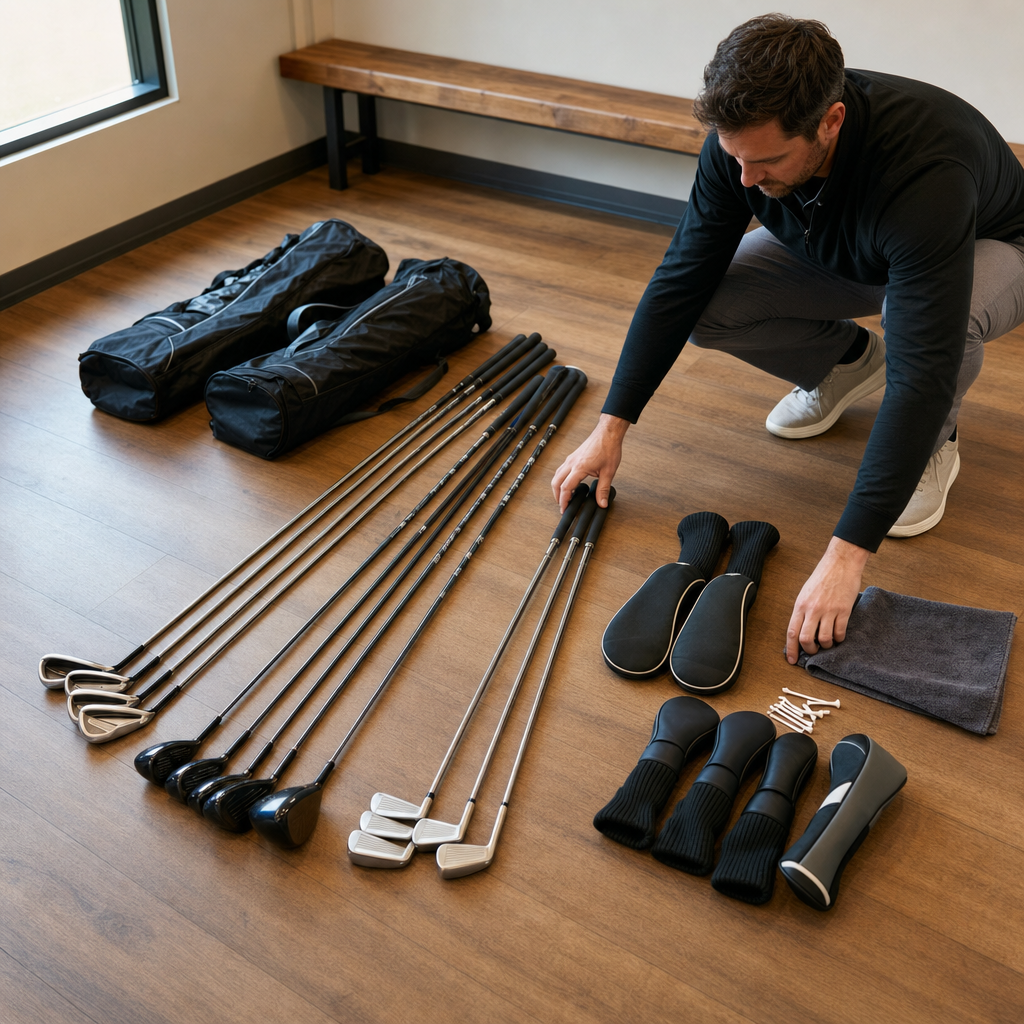
Separate the inventory into actual golf clubs, the bag, headcovers and other accessories. You can note the count for each group, but do not add them together under ‘number of clubs’.
Example breakdown of two ten-item packages
| Check | Package A | Package B |
|---|---|---|
| Stated total | 10 items | 10 items |
| Actual clubs | Driver, hybrid, 7 and 9 irons, wedge, putter: 6 clubs | Driver, wood, hybrid, 6 to 9 irons, wedge, putter: 9 clubs |
| Bag | 1 item | 1 item |
| Headcovers and other items | 3 headcovers | Not stated |
Both example offers state ten items, but the first contains six clubs and the second nine. That does not yet determine which set is more suitable. It simply shows why accessories must be counted separately.
For each club, note its stated type and the function it should cover: a longer shot, a transitional distance, shorter play or putting. Leave an unclear designation as something to check. Assess the bag for carrying and storing equipment, and headcovers for protecting specific clubheads. A beginner golf set with a bag can be practical, but accessories do not replace a missing club.
Finally, add three notes to every package: ‘uncovered function’, ‘possible overlap’ and ‘room to add’. From then on, compare only options with clearly listed contents. You can then decide which of the stated functions you genuinely need for the way you play.

The first decision branch: driving range, course and playing frequency
With a clear inventory, ask yourself two questions: where will I mainly play in the near future, and how often will I actually use my own clubs? The answers determine which situations your equipment must cover straight away and which can wait.
- Mainly the driving range: prioritise functions for the distances you practise repeatedly. Include play around the green and putting among your immediate needs only if you genuinely practise them there.
- Occasional shorter-course play: allow for an opening shot, medium and shorter distances, play around the green and putting according to where you will play. Do not buy ahead for hypothetical situations.
- More regular course visits: cover a wider range of repeated situations, from longer shots to putting, but not exceptional needs that merely increase the number of clubs.
Frequency alone does not determine the number of clubs. It shows how soon a possible gap will start to limit you. A player who regularly practises mainly at the driving range may prioritise a progression of practice distances. A beginner heading to the course more often is more likely to need coverage around the green and for putting too. The answer to how many golf clubs a beginner needs is therefore a set of recurring functions, not a universal number.
Divide the result into two lists:
- I need it now: situations you expect in most practice sessions or rounds, where lack of coverage would genuinely limit you.
- I can add it later: rare or still hypothetical situations where you do not yet know whether you will face them regularly.
These lists determine whether you need a broader ready-made set, a more economical set or equipment built up gradually.
The second branch: a complete, half or gradually built set
Use the ‘I need it now’ and ‘I can add it later’ lists as a filter when choosing how to assemble your equipment. What matters is immediate coverage, the number of separate choices and scope for later expansion.
The names do not prescribe a specific number of clubs. A complete set is a broader pre-assembled package, not a guarantee of completeness for every player. A half or partial set means a smaller range, not necessarily exactly half of a larger set. With gradually built equipment, you choose individual parts separately.
Three ways to build your first golf set
| Assembly method | What it solves immediately | Main trade-off | Scope for adding to it |
|---|---|---|---|
| Complete set | Broader coverage in one choice | Predefined composition | Adding identified gaps |
| Partial set | Selected current needs | Deliberate gaps | Expansion to a plan |
| Built-up equipment | Choice of every element | More checks and decisions | The greatest flexibility |
A complete option reduces the number of separate choices, a partial set postpones some decisions, and a built-up set offers the most control. Suitability, however, always depends on how well it matches your minimum and expansion plan.
- Compare coverage. If a set handles everything on your ‘I need it now’ list without significant overlap, it can remain under consideration regardless of its label.
- Name the gaps. Keep an incomplete set in contention only if you know what you will add and doing so will not require replacing a substantial part of the setup.
- Separate the surplus. Items on the ‘I can add it later’ list are not automatically an advantage simply because they are included in the package.
- Consider the complexity of the choice. If you cannot yet assess individual clubs, built-up equipment may bring more uncertainty than control. A ready-made foundation with a considered expansion plan may be more practical.
A beginner who mainly practises for now may prefer a partial set if it covers their current minimum. A player going to the course more often may appreciate a complete set if its fixed composition matches their broader list of needs. Built-up equipment makes more sense for someone who already knows which choices they want to make separately.
Once you have chosen a route, assign every planned club a specific role. Only then will it become clear whether the set label is concealing gaps or duplicates.
Functions, not filler: what each club in a first set should do
Complete this sentence for every club: ‘I will use it for…’ If you cannot name a different role from the neighbouring club, another club is not automatically beneficial. Your first set of golf clubs should cover the situations you need, not a compulsory list of names and numbers.
An illustrative functional map, not a universally recommended set:
- Longer shots: a wood or another stated alternative can fulfil this role. A driver does not have to be an essential starting point for everyone. What matters is whether you want to cover this function immediately and whether another club already does so.
- Transitional distance: a hybrid is one option. It makes sense when it fills a specific gap and does not unnecessarily overlap with a wood or longer iron.
- Medium and shorter distances: assess irons as a connected group, not as a compulsory uninterrupted numerical sequence. A missing number alone does not mean a missing function.
- Short game and around the green: set this role aside for a wedge rather than assuming all irons cover it automatically.
- Putting on the green: belongs to the putter. Its function is not replaced by a club for either longer or shorter shots.
When looking for overlap, compare the stated type, loft where the product page gives it, and intended role. Different names do not necessarily mean different needs, and a club number alone does not explain the whole difference.
For example, with a setup containing a wood, hybrid and longer iron, do not automatically treat all three as three separate needs. First assign each one a role. If two retain the same role, one is more likely to be a possible addition or a probable duplicate.
Overlap is not always a mistake: two similarly focused clubs can deliberately offer an alternative. However, you need to know why you want both. The answer ‘they were in the package’ does not confirm a different function.
Finally, mark each club as ‘needed now’ , ‘possible addition’ or ‘probably a duplicate function’ . Record a missing role as a gap. Do not fill it with any club simply because it commonly appears in sets. The result is your own functional minimum, which must pass checks for handedness and dimensions.

Hard stops: handedness, length and grip must fit
A functionally good setup may still be unsuitable. For every specific set, therefore set aside the item count and appearance, and apply three exclusion checks. If you cannot confirm any of them, the offer does not proceed for now.
- Confirm handedness. A right- or left-handed golf set must match both the version being ordered and the stance in which you actually play. Do not infer it automatically from your dominant hand. If you are unsure, check through a personal trial or with a coach, and make sure the information applies to the selected variant.
- Check the length. Look for whether a standard, extended, shortened or otherwise stated length is given. Do not infer missing information from a photo or the label ‘for beginners’. The right golf club length for a beginner cannot be reliably confirmed using one fixed height chart. If the information is insufficient, check comfort in your stance and handling of the club during a trial.
- Assess the grip. Record the stated grip size and shape where available, and check whether they apply to the whole set. A markedly uncomfortable grip is a reason for further checking, not a compromise offset by more extensive contents.
Record the result as passed , stop or needs checking . The final status is not provisional approval: do not compare the offer as an equal with compatible alternatives until the uncertainty has been resolved.
The label ‘one size’ alone does not confirm suitability either. Where length is uncertain, the grip is unsuitable or body proportions are non-standard, move the decision to a personal trial or professional fitting.
Example situation: a set covers your functional list, but the product page does not state the handedness or length version. The photo does not confirm the variant being ordered. The result is stop until the partner retailer confirms both details.
The rule is: handedness confirmed, length checked, grip acceptable . Only then does it make sense to compare the shaft, where the issue is no longer a hard stop but specific trade-offs.
A shaft is not just material: compare weight, flex and feel
With shafts, the selection logic changes. Neither steel nor graphite is a universal answer for a beginner. Material is only the first piece of information, not a ready-made recommendation. What matters is the specific combination of stated parameters and feel during a comfortable swing.
For each version, note the material, stated weight and shaft flex, meaning its stated degree of flexibility or stiffness. The information must apply to the exact set variant, not merely the product range. Also check whether the description applies to every club or only part of the setup. Do not infer flex from weight, or vice versa.
Example: two golf-club shafts are graphite, but the first has a stated lower weight and softer flex, while the second has a higher weight and stiffer flex. The material is the same, but the parameters are not. The simple label ‘graphite’ would hide this difference.
During several relaxed swings, ask yourself three questions:
- Can I manage the club without having to force a change in my tempo for it?
- Does it feel similar from one swing to the next, or can I not find a consistent feel with it?
- Can I focus on natural movement, or do I have to adapt my entire swing to the shaft?
Do not judge by one attempt. Look for a repeatable feel at a normal tempo, and do not automatically attribute every difference to shaft material, because during a trial you experience the whole club configuration.
If an offer does not state weight or flex, mark the shaft as unverified. If a personal trial is not possible, do not confirm suitability based only on the label ‘for beginners’. If unsure, compare several versions in person or choose a fitting. The result should be an acceptable combination of parameters and feel, or a preference to ‘confirm by trial’. Apply the same requirement to both new and used equipment.
New or used clubs: condition and the route to a complete setup matter
Apply the functional minimum, handedness, length, grip and shaft requirement equally to new and used setups. The question is not only ‘new or used golf clubs for a beginner?’, but ‘what still needs checking or adding for this option to make a suitable whole?’
- For a new set check the exact stated contents and parameters of every club. A new package does not guarantee a match with your minimum or suitability of every part. Assess the specific variant, not simply the label ‘complete’.
- For a used set add checks of physical condition and previous modifications. A complete item count does not help if the parameters do not match, a part is significantly worn, or the length was changed without clear information.
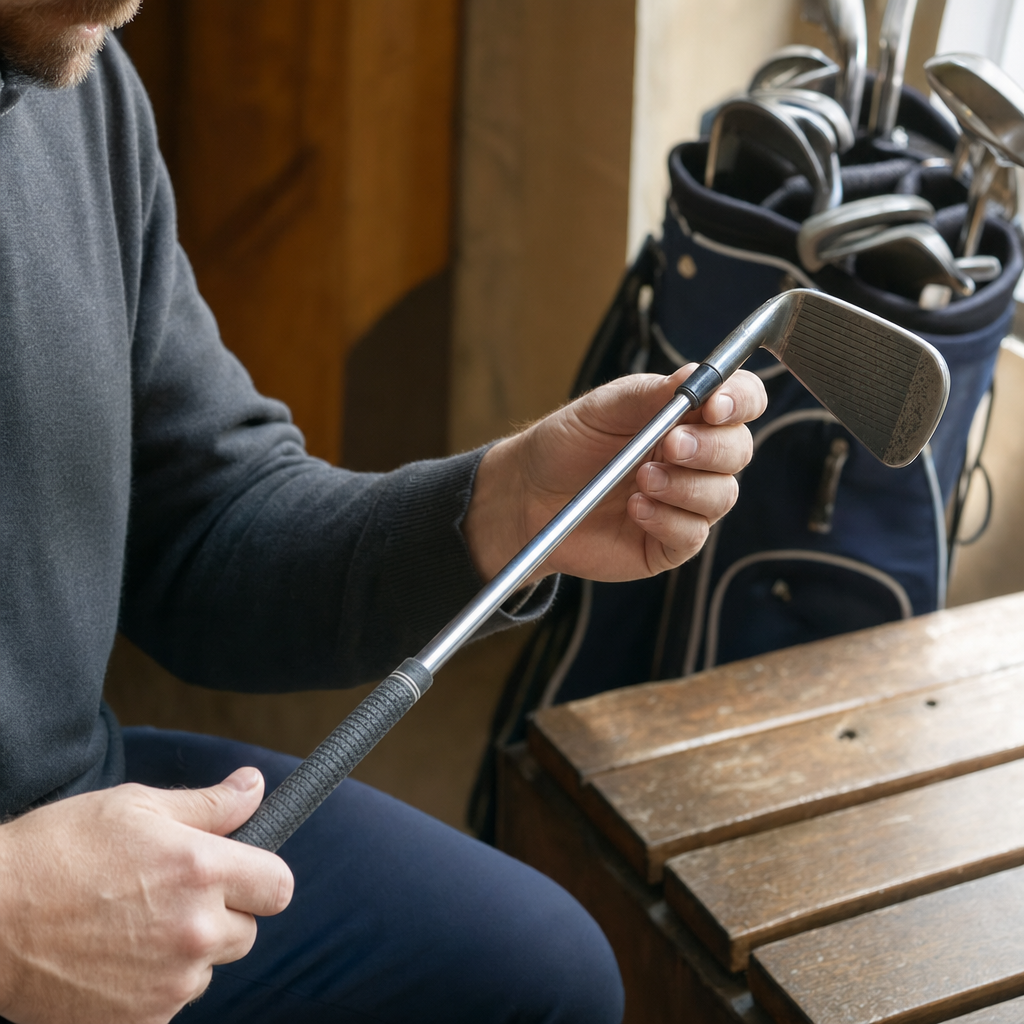
For used clubs, check the condition of clubheads and faces, shafts, grips and the joins between head and shaft. Find out whether they have been shortened, extended, regripped or modified in another way. A modification itself need not rule a club out, but its extent and resulting parameters must be clear.
Record missing clubs and mismatched parameters separately from wear. Assess the bag, headcovers and accessories separately too: a well-kept bag does not compensate for a damaged club, and a worn bag does not change the functional suitability of the clubs themselves.
An example used golf-club set may seem attractively priced, but lack a club for the required short game, while it is unclear whether the irons have been shortened. Its original appeal must therefore be reconsidered based on uncertainty about modifications and the route to adding the missing function. Check the availability of a suitable addition. Do not assume you will find one later without difficulty or that it will not create further overlap.
Compare the steps needed to achieve a functionally complete and compatible setup. If the condition, modifications or real possibility of adding to a used option cannot be checked, rule it out for now regardless of the stated price.
The rule before ordering: proceed or stop
For a specific offer, also confirm that all verified features apply to the variant that can be ordered. Create a check card for every option and use the status ‘confirmed’, ‘unconfirmed’ or ‘not applicable’ for each line.
- Record the facts about the variant. State the exact list of clubs, right- or left-handed orientation, stated length, shaft material, available information on its weight and flex, grip, bag, accessories and stated ability to add to the set. For a used option, add its condition and modifications. For a new one, add the exact version designation.
- Mark uncertainties with the word ‘stop’. If the page states only the number of items but not the club list or handedness, do not infer the contents from the photo or name. Neither the label ‘complete’ nor ‘for beginners’ confirms missing information.
- Separate product information from live conditions. First check an unclear variant or contents on the product page, then with the partner retailer. Ask about the specific version, not the product range in general. Also confirm the current price, availability, delivery and applicable retailer terms with the retailer, as these are live details.
- When unsure, choose a trial or fitting. Professional fitting makes sense if the stated information is insufficient to assess comfortable length, grip or shaft, or if a one-size version remains questionable.
- Compare only like-for-like options. When comparing on Zoneo, use the same check card only for offers with matching contents and confirmed parameters. Zoneo helps with comparison. It is neither the seller nor a guarantor of retailer availability or terms.
- Decide: proceed or stop. Proceed to price comparison only when contents and compatibility are confirmed. If a missing function is to be added later, that route must be verifiable too. Put the offer on hold when a material question remains open.
The rule for your first set of golf clubs is simple: compare prices only after confirming the contents, handedness, length, grip, shaft and ability to add to the set — never instead of them.