
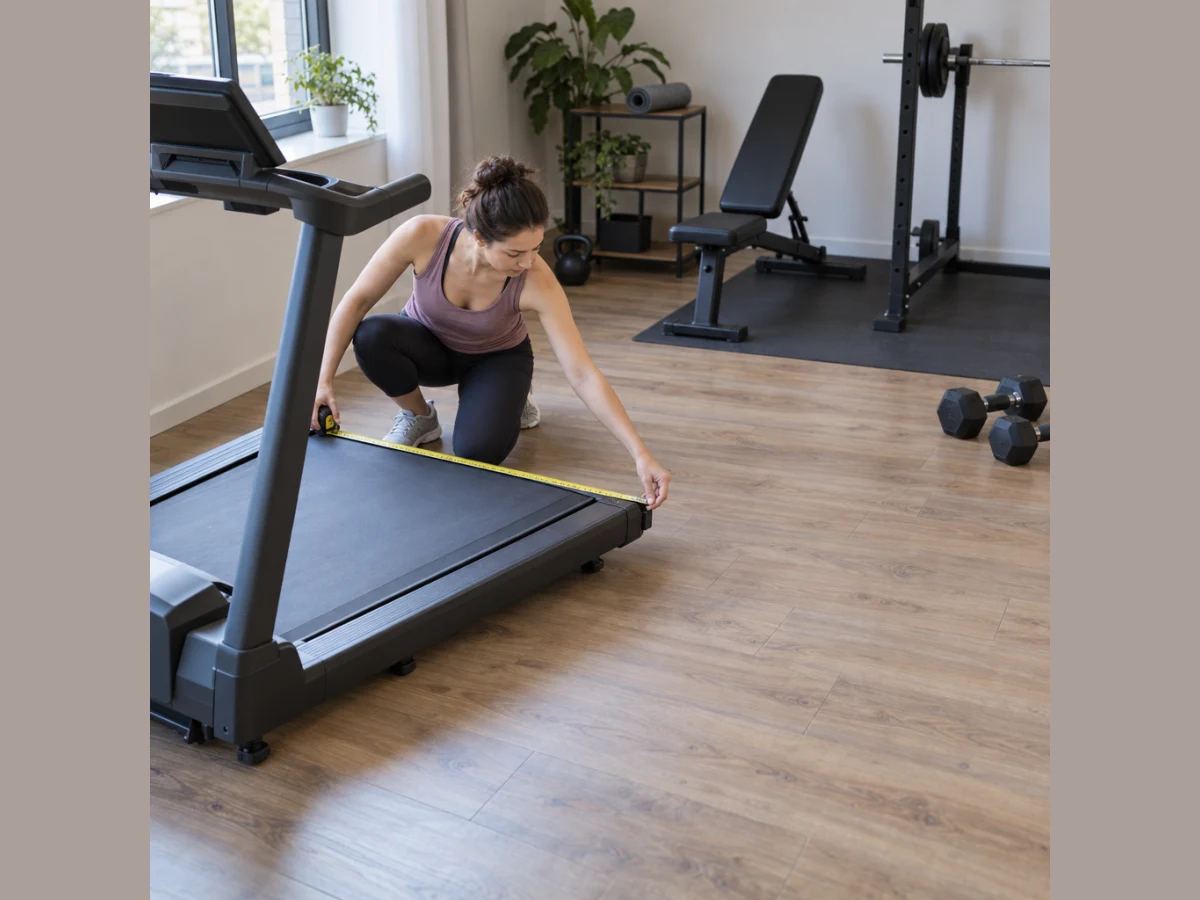
A treadmill, a rack with narrow contact points and an area for working with weights can stand on the same floor, yet load it differently. So simply asking “rubber or foam” is not enough. The way the load acts, possible vibrations or impacts, and the size of the area that needs protecting all matter. This process will help you choose between a standalone mat, foam tiles and rubber flooring without looking for a universal winner.
First, identify what will load the floor
Start with how the equipment transfers load to the subfloor — not by choosing rubber, foam or a ready-made mat. The same total weight does not necessarily mean the same demands: what matters is where and how it acts.
- Concentrated static pressure: The feet of a rack, bench or machine transfer load through small contact points, while a wider base spreads it over a larger area. With narrow supports, consider how the specific layer performs, not just the name of the material.
- Repeated movement and possible vibrations: A treadmill or exercise bike does not load the subfloor only statically. If you are looking for a vibration-reducing mat for fitness equipment, check its intended use and construction; the word “rubber” or “foam” alone does not guarantee cushioning.
- Normal movement during exercise: Steps, changes of stance or moving a bench affect a different part of the subfloor from a machine that remains in one place. The protective layer must remain stable during movement too.
- Possible impacts: Handling free weights is not the same as setting down a dumbbell in a controlled way. If something could be dropped, suitability for reducing noise and impacts beneath weights must follow from the intended use of the specific product.
In a combined workout area, assess each part separately. A rack on narrow supports, a treadmill and an area for handling weights may need different solutions. Note the dominant type of load for each zone, then decide how far the protection should extend.
One machine or an entire workout zone?
Once you know where the load occurs, map out how far it extends. Protection does not have to end at the outline of the machine, nor does it automatically need to cover the whole room.
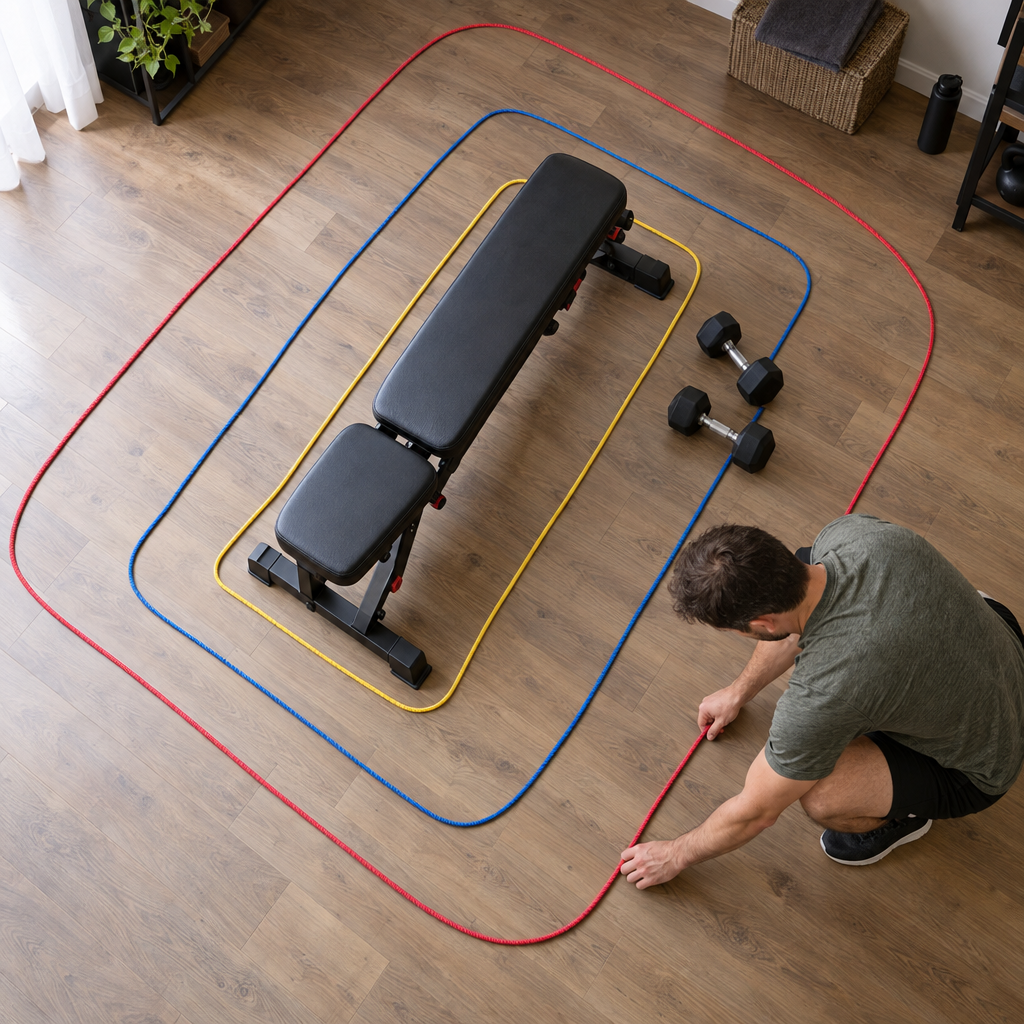
On a simple plan of the workout area, distinguish three areas:
- Equipment: the full footprint of the machine, bench or rack, including the position of its contact points.
- Movement during exercise: space for getting on and off, changing stance and accessing the equipment.
- Handling equipment: the space through which you move a bench, weight plates or dumbbells, and where you use them.
Draw the boundaries separately, even if they overlap. The overlaps will show whether a small protected island beneath a machine leaves a substantial part of the used area unprotected.
A standalone mat for fitness equipment makes sense in terms of coverage for one fixed footprint. If the layout changes or you exercise between several stations, consider an adaptable modular zone. When movement and loading affect most of the area, home gym flooring may require a more continuous area of protection.
For now, define only the boundaries. You can resolve the exact dimensions and required allowance when considering a specific offer; first, however, you need to check the existing floor.
The existing floor is a starting condition, not a minor detail
Now assess the mapped area from the bottom up. Check that the subfloor is level and firm, and that the equipment does not wobble on it. A protective layer should not be expected to correct an uneven or unstable subfloor automatically.
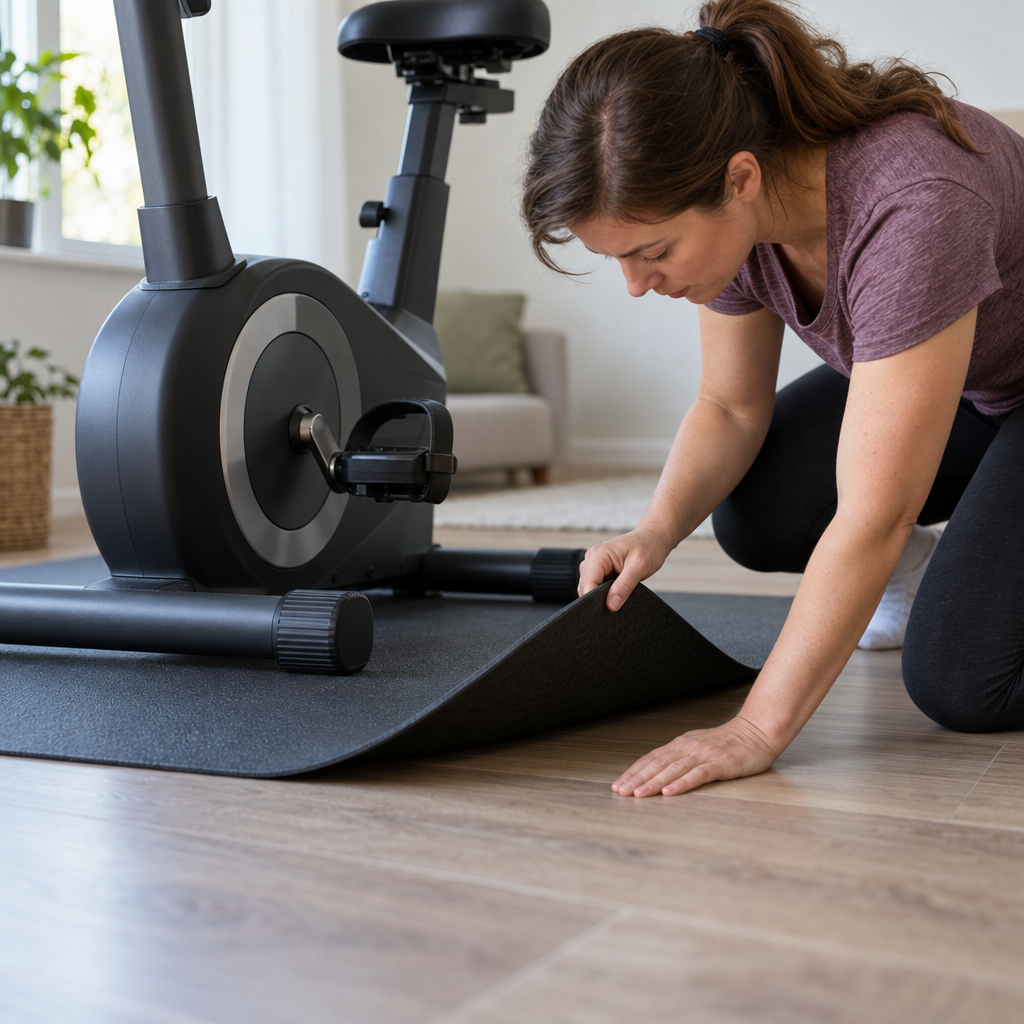
If you are protecting a floating floor beneath an exercise bike, the subfloor may be level, but surface sensitivity is the first thing to check. In the information for the specific product, verify whether its underside is intended for long-term contact with that type of floor and what installation conditions the manufacturer permits. With an uneven subfloor, the order is reversed: first create a level, stable base, then choose the protective layer.
Consider two separate interfaces. The first is contact between the mat and the existing floor: during normal use, it should not slide or ripple unintentionally. The second is contact between the equipment and the mat: the supports must stand securely and the layer beneath them must not compromise stability. If only one interface is satisfactory, the setup is not resolved.
Consider maintenance too. Check whether the mat beneath fitness equipment can be lifted or taken apart, whether the subfloor can be inspected, and whether both contact surfaces can be cleaned in a way permitted by the manufacturer. Only then does it make sense to compare the three types of solution.
Rubber, foam tiles and a standalone mat suit different situations
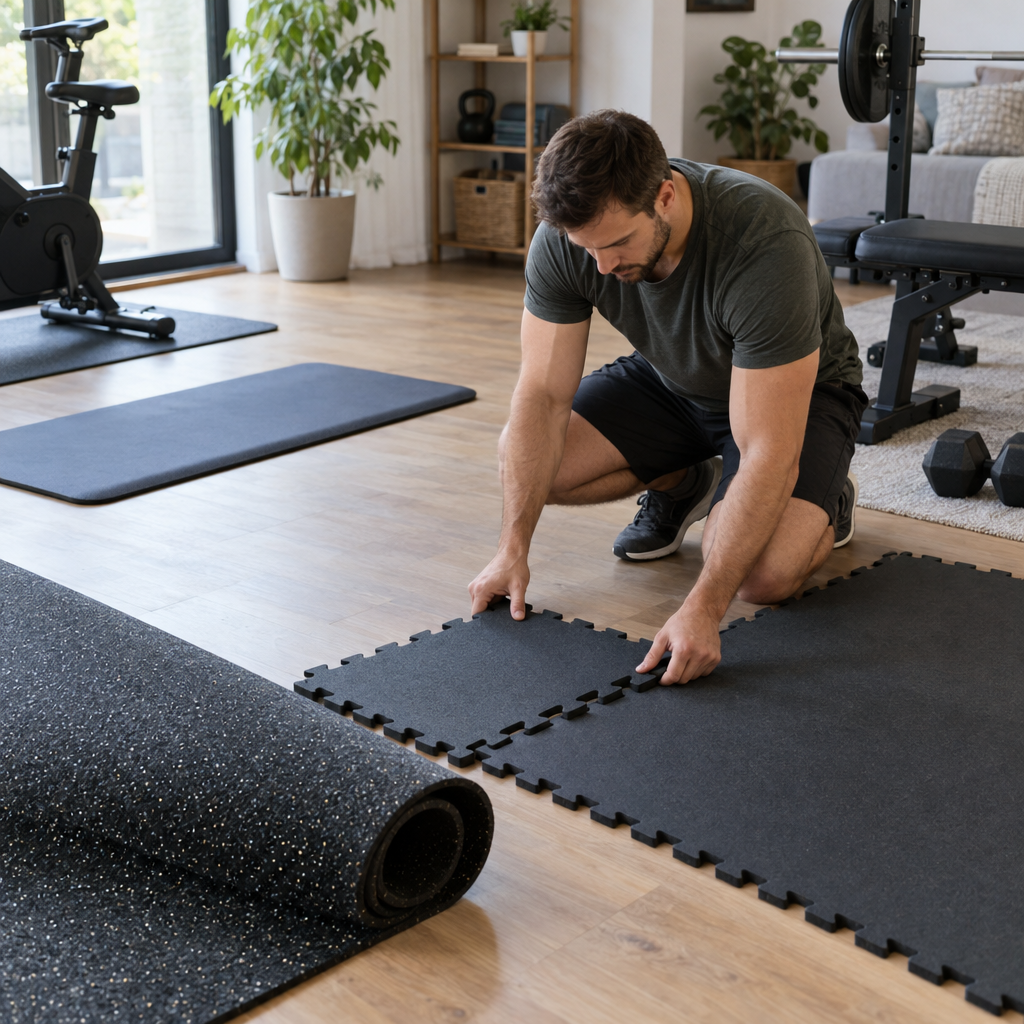
With the subfloor checked, you can compare the protection formats themselves. For each option, consider the same factors: the stability of the specific construction, the number and position of joins, the ability to move it or change the layout, maintenance and coverage. These differences matter more than the simple choice of “rubber or foam flooring for exercise”.
Standalone mat: a precisely defined footprint
For someone with a single exercise bike, a standalone mat makes sense when its shape and area match a clearly defined space. One piece has no internal joins and, depending on its dimensions, may be easier to lift, clean or move. Its limitation is its coverage: it protects only the area it actually covers. With an unusual footprint, fixed edges can also get in the way.
Foam tiles: adaptability at the cost of joins
Foam tiles for exercise machines make sense for a user who wants a changeable workout zone. The pieces can be adapted to the layout and rearranged later, but modularity brings more joins. For a specific product, therefore check the rigidity of the tiles, their behaviour beneath narrow contact points and the stability of the joins during movement. Being able to take them apart can make it easier to access the floor and replace part of the area, but it also adds gaps and edges that need maintenance. The name “foam” alone does not determine these properties.
Rubber flooring: more continuous coverage, not a performance guarantee
For a larger permanent area, rubber flooring may be worth considering, especially if you need more continuous or more robustly designed coverage. The format also matters: rolled flooring, separate tiles and a single piece have different numbers of joins, edges, dismantling options and moving requirements. Rubber flooring beneath weights in a home gym is not an automatic guarantee of noise, vibration or impact reduction. Such intended use must be verified for the specific product, along with cleaning methods and conditions for contact with the existing floor.
A local mat favours one fixed footprint, tiles favour a changeable zone, and rubber flooring favours more continuous coverage. The acceptable compromise becomes fully clear only with the specific equipment, which tests the edges, joins and stability.
Three scenarios where an unsuitable mat shows up differently
With specific equipment, it becomes clear whether the protection suits its supports, movement and area of use. Suitability for possible vibrations or impacts must always be declared for the specific product; it cannot be inferred from the word rubber or foam alone.
Treadmill or exercise bike
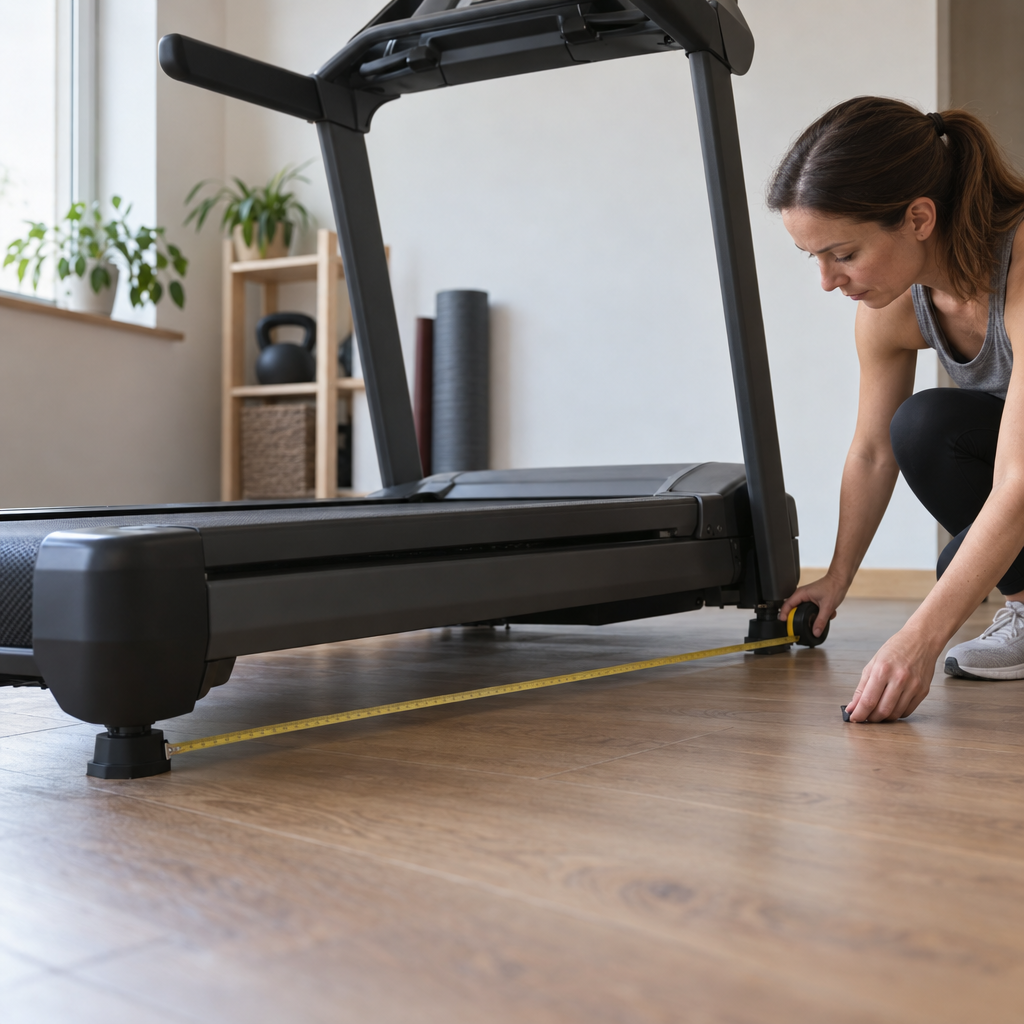
If you are deciding how to choose a treadmill mat, consider the entire footprint and contact under all supports, not only the middle of the machine. Rule out a mat that is shorter than the base, shifts during use or leaves a support close to an edge. For an exercise bike, assess stability while pedalling, not only when the equipment is stationary.
Bench or rack
With a bench and rack, narrow contact points are often decisive. If one foot stands on the edge of a tile or on a join that separates during use, the setup may not have equal support everywhere. A soft construction with no verified suitability, into which the supports sink significantly, is also a risk. Rule out such a combination or change the layout so that a contact point does not rest on an uncertain join or edge.
Free weights
With free weights, the storage location alone is not decisive. Assess the exercise area, carrying route and set-down area separately. A small protected island may work beneath a dumbbell rack, but it does not cover the whole area where you handle the weights. Nor does rubber flooring beneath weights in a home gym alone confirm suitability for impacts; the manufacturer must explicitly state this for the specific construction.
In an area with an exercise bike and free weights, it may therefore make sense to use local protection beneath the machine and a separately designed wider zone for handling weights. One material or one thickness does not have to be the answer for both. Do not transfer the declared intended use from one scenario to another: a mat intended for use beneath a machine may not be intended for impacts. After ruling out unsuitable combinations, the specific parameters still need to be checked.
What to check for a specific mat or floor
Once you know the suitable type, compare the specific details in the product listing and instructions. A mat for fitness equipment must suit your scenario in its dimensions, construction and intended use.
- Dimensions and allowance: For a treadmill, note the entire footprint, the exact position of every support, space for getting on and access to the equipment, as well as an allowance for handling. Only then look for a matching format; the machine’s nominal dimensions alone do not show where the supports or mat edges end.
- Thickness and construction: The right thickness for home gym flooring is not a single figure. Assess it alongside the construction, rigidity or other manufacturer information, the type of load and the declared use. Greater thickness alone does not confirm stability or suitability for vibrations or impacts.
- Surface, edges and joins: Check the stability of contact with the equipment feet. Make sure edges are not where you get on or move equipment, and that a join will not be directly beneath a contact point.
- Format and installation: Distinguish between one piece, tiles and rolled flooring. Check the product construction, installation method, any fixing requirements and use restrictions in the instructions.
- Contact with the floor and maintenance: When protecting a floating floor beneath an exercise bike, check the conditions for long-term contact, permitted cleaning methods and whether the mat can be lifted to inspect the area underneath. Follow the instructions for the specific surface.
- Current offer conditions: Check the price, availability, delivery, any additional charges and seller conditions in the partner shop before ordering; these are not fixed product characteristics.
Do not replace missing information with an estimate. Mark it as a question for the manufacturer or seller; further selection only makes sense once you have comparable answers.
Decide in this order: load, area, elimination, parameters
Use the information collected first as filters, rather than to compare all offers immediately.
- Load: for each part of the workout area, identify the dominant issue — static pressure, repeated movement, normal movement during exercise or possible impacts.
- Area: decide whether protection ends beneath one item of equipment, should create an adaptable zone or a more continuous area.
- Elimination: set aside options that are unstable once installed, insufficient in size or lack verified compatibility with the existing floor. Unclear information needs checking, not replacing with an assumption.
- Parameters: only among the remaining options, compare dimensions, construction, thickness, surface, edges, joins and maintenance according to the product documentation.
If one mat for fitness equipment does not suit both a machine and working with weights, divide the space into functional zones. Home gym flooring does not have to be the same everywhere. Rather than a universal winner, you will get a solution for how the space is actually used. Before ordering, check the documentation for the specific product and the current conditions in the partner shop.